2 November 2026
Interviewed by: Elizabeth Ransom
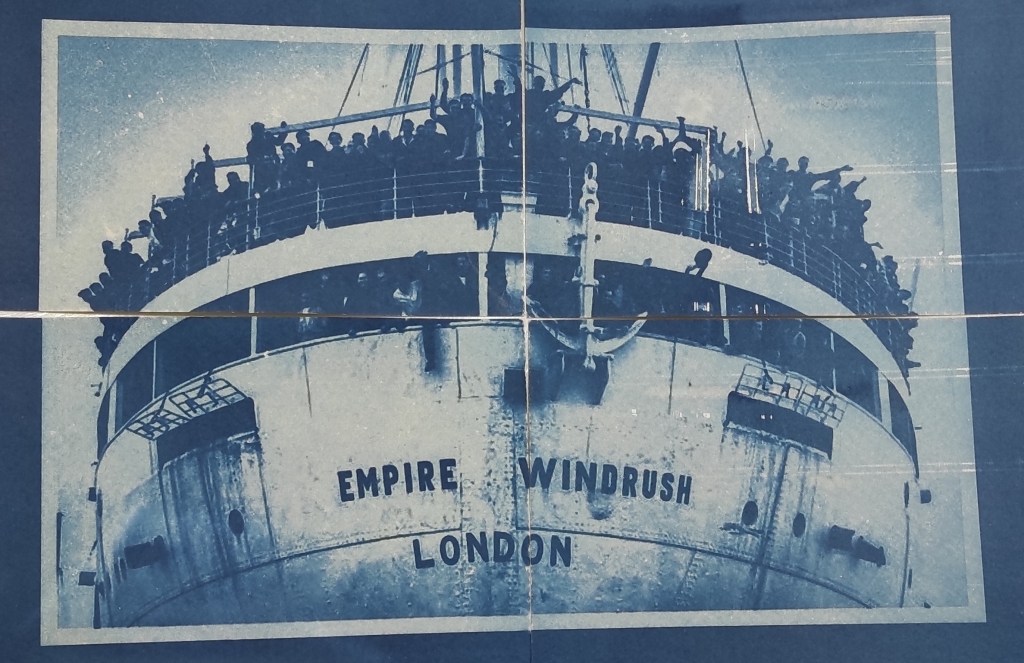
Between 1948 and 1971 people from the Caribbean were invited to immigrate to the United Kingdom to help rebuild the nation after World War II. At this time many countries within the Caribbean were under British colonial rule and were a part of the Commonwealth. The generation of people who moved to the United Kingdom during this time are known as the “Windrush generation” named after HMT Empire Windrush ship that arrived on June 22, 1948. Artist Wendy Leocque uses alternative photographic practices to explore what migration, belonging, and identity mean for the Windrush generation and their families.
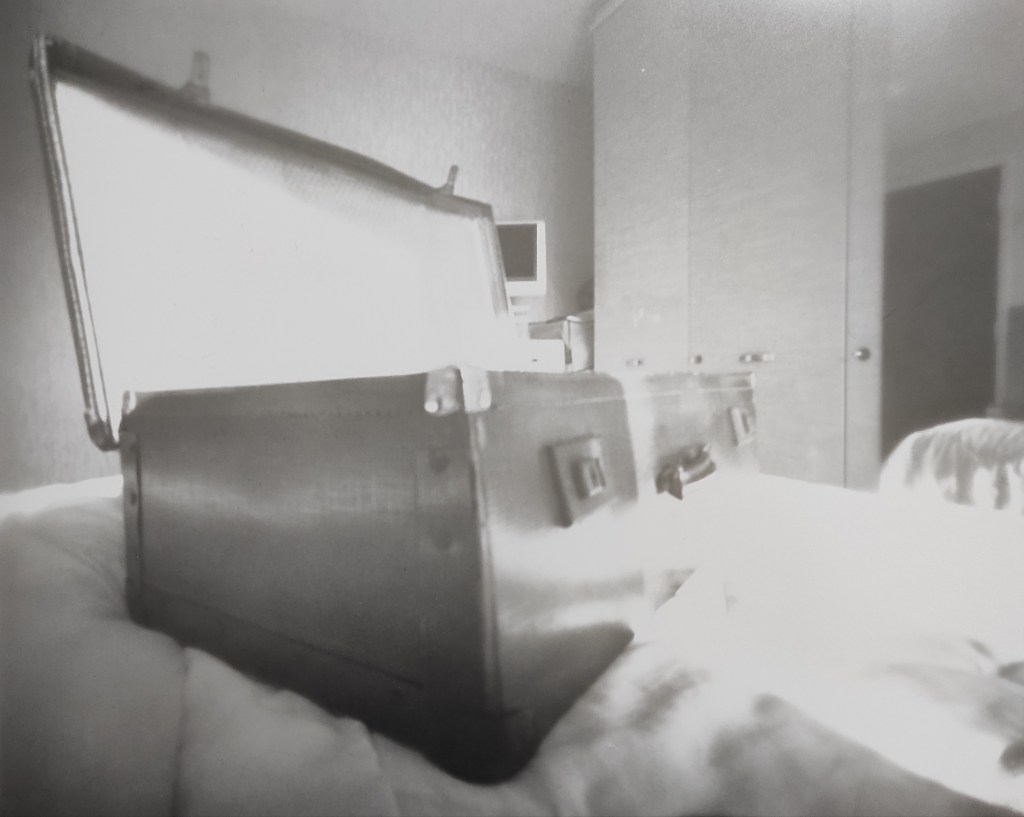
Elizabeth Ransom: Your grandmother was one of the many people who made the journey from the Caribbean to the UK as part of the Windrush generation. Can you tell us a little bit about her story and why you chose to build a pinhole camera made out of her suitcase?
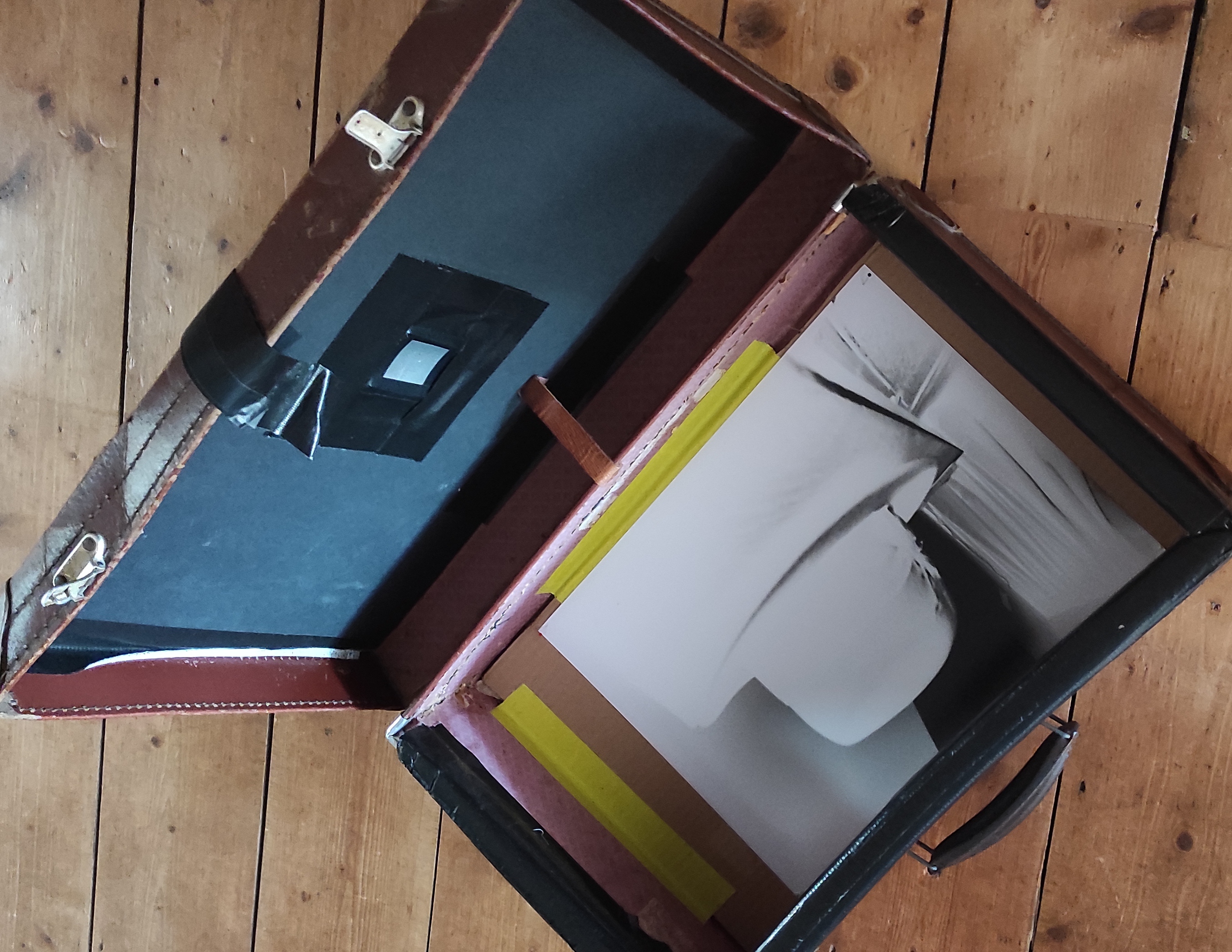
Wendy Leocque: My grandmother came to the UK in her mid-twenties and like many others from British colonies, she was answering the call to help rebuild Britain after World War II. It was her aunt who suggested that she take the opportunity to travel to the UK, when she learned that there were a lot of job prospects. As a young single mother, it was an opportunity my grandmother needed to consider. Her aunt thought that she would be able to make a good life for herself, while helping to provide for the family in Jamaica. After the talk, my grandmother said she cried a lot, but eventually agreed to go. She recalls her aunt having to sell a cow to raise enough money for her ticket. Her journey took her almost three-weeks by ship and she travelled alone, with a few belongings in her grip [suitcase]. This grip is the foundation of my work. I chose to turn it into a pinhole camera and take images of what I interpret as Windrush artifacts, because as a photographer its an object my grandmother held, it belonged to her. Everywhere she moved, everything she saw and went through, she kept it with her. She gave it to me many years before she passed away and it then travelled to every place I lived. I kept it to transport various items, to store things in, to keep things safe. It is, in itself, a Windrush artifact. My grandmother brought all her knowledge, experience and culture with her, but the landscape she came to was harsh, both in temperature and welcome. When she found lodgings, it was one-bedroom in a shared house and from this base she quickly found work with other Windrush arrivals. It was four and a half years before she saved enough money to send for her daughter, my mother. She gave clear instructions on how my mother should be dressed, so that she could easily identify her. She knew that her daughter may not remember her since she was only 4 when my grandmother left, so she wanted to be able to spot her quickly. My mum described being taken back to her new home with my grandmother and said it was very different to how she had grown up in the endless sunshine of the Caribbean, in a big house with a veranda. One-bedroom in a shared house would be home to them for another 8 years and they would move many more times from room to room around the Midlands.
Arriving in 1956 on her British passport, my grandmother came to the UK as a British subject. Her whole life was contained in one grip, and I see it as something that held all her dreams. I was curating an exhibition of portraits in 2020 of the Bristol Windrush generation, by photographer Garfield Mckenzie, when my grandmother’s grip became my exploration into my own personal story around Windrush. It was a Windrush artifact that was mentioned several times by Windrush elders and visible in many of the iconic images of them arriving at ports and stations in England. Using this traditional, archaic process would be the shaping of this project and the start of a long-term, slow collection. The HMT Empire Windrush wasn’t the first ship bringing Caribbean migrants to the UK, but it was the most high-profile and had a lot of press coverage. This ship gave the entire generation its name and in 1971 when the Immigration act changed, an extended window saw the last of this generation arrive around 1973. By the late 1980’s and early 90’s people like my grandmother, the Windrush generation, had begun to quite literally change the face and landscape of Britain forever. Knowing that we need to tell our own stories and document them from our personal perspective, is the reason why I continue to do this work.
Elizabeth Ransom: For your project you have chosen to photograph Windrush artifacts. Could you share with us some of the objects you photographed and why you chose to photograph them?
Wendy Leocque: I often think of the collection as the ‘tell me without telling me’ trend. Communicating something with visual cues and clues, that are easily recognizable to people who understand them and are intimately aware of their meaning. Sharing identities through recognizable objects, helps not only to build strong community through this cultural shorthand and these connectors, but also gives greater understanding in a wider context.
The ‘trilby’ was a favoured accessory of my grandmother. It reminded her of her father and for someone so far away from home these objects became a comfort and physical connector. For me, it’s a reminder of my grandmother, who herself liked to wear a trilby from time to time. Its also reminiscent of the sharp ‘Sunday best’ Caribbean dress code, prevalent during the 1950’s and 60’s. Those smartly dressed Windrush arrivals photographed disembarking the Ship, would not have felt complete without their trilbies. It was familiar garb used by prominent black artists like Linton Kwesi Johnson and musicians of the Two-tone and Ska genre, like Pauline Black, lead singer of ‘The Selecter’. At my grandmother’s funeral, we wore trilbies as a tribute to her, so for me, it had to be part of the series.
The ‘grip’ was something that all Windrush arrivals came with and owned. Its a symbol of humble beginnings and an object that travelled and endured. Something that was filled and emptied and waited to be filled again. Its an object that can quite literally contain your memories and the things you wish to hold on to. I could have purchased a similar looking suitcase to represent my grandmother’s journey, but to have the item she held, that travelled with her, creates something beyond it’s function, its expansive. When I discussed my project with my mum, she explained that she still had her grip and she immediately went routing around a cupboard to find it. A collaboration between my mum and I began, as she suggested other items I should document. One of her suggestions included the ‘trunk’. She reminded me that the plan was to stay for only five-years, work hard, save as much money as they could and then return home. Unfortunately for them, this dream was never realized. As their families and connections in the new country grew, so did the gap of their dream to return. They hardly earned enough to be able to be able to save. The cycle of low wages and rising costs kept them from fulfilling their plan. The trunk is symbolic of family archives and collections. What do we keep safely stored away and what do we value?
The image of my ‘grandmother’s bedroom’ was the first image I created with my pinhole camera and I’ve always felt that this first image chose itself. I wasn’t looking for an object or artifact as such, just a connection to my grandmother, her essence and memory. When I walked into her bedroom, it was quiet and still. She had passed away around 10 years prior and towards the end of her life, this is the very room she would spend much of her time. I would usually find her sat upright in bed looking out of the window. As I stood in this room looking at the bed, I was drawn to her side. I placed the grip in the same position I would find her, upright leaning back against the headboard. The resulting image was almost poetic for me. Resting the pinhole camera back at an angle gave the vignetting effect and I hadn’t intended there to be any loss of detail in the net curtains at the window, but the light streaming through the window offered me a perfect metaphor. Of all the images I have taken to date, this for me is the most powerful, the most personal and the most meaningful. It was as if she was with me throughout the 18-minute exposure. I’ve often described this image as dreamlike. As if there was something that still needed to be said, which was finally conveyed in this one image.
It’s a slow process. For each artifact, I have mainly taken them around the house I grew up in. First, I load 12×16 paper inside the [grip] pinhole camera in my darkroom in Bristol. I then take my pinhole camera to Birmingham, set up the study, guess the exposure and expose the paper negative, then close the shutter with my very technical piece of electrical tape. Once I bring it back to Bristol, the latent image will wait until I can get to a darkroom to use developing trays big enough to submerge the paper negative and develop out the image. There’s always a bit of anxiety waiting to see what appears, but my excitement far outweighs these feelings.
Elizabeth Ransom: This body of work is deeply personal and uses not only items that belonged to your grandmother, but your mother as well. Many of those who moved to the United Kingdom had to leave behind their children. Your mother was one of the children who was left behind. These children were sometimes known as barrel-children. Could you explain to us what that means for your family and how this experience shows up within the work?
Wendy Leocque: When the Windrush generation began making the journey to the UK, they often left their children behind with family members. It would have been too much for them to come to a new country, find somewhere to live, a place to work and ensure they could manage the first few months, if they had their children to worry about too. Even though my mother was left in Jamaica to be cared for by family members, responsibility would remain with my grandmother to ensure her needs were taken care of. Financial help towards my mother’s keep, such as food, clothes for school and church, and if finances allowed, there may have been a few treats. Once families were settled in the UK, they began shipping goods back home in barrels for their families. During a discussion I had with some Windrush elders for a book I produced, they talked about what it was like to receive the barrel as children, describing feelings of excitement and not being able to wait until it was opened and once it was, it was as if ‘all their Christmases had come at once’.
The term ‘Barrel Children’ was coined by Dr. Claudette Crawford-Brown, a Jamaican academic at the University of the West Indies. She noted that instead of direct parental care and emotional support, these children primarily received material goods, clothing, food and gifts shipped in large cardboard barrels from overseas. It is in reference to these barrels that the term became associated with those children. Exploring the phenomenon, Crawford-Brown examined the psychological impacts. For some children, it was a reminder of a parent that no longer cared for them in the physical sense. For others separated from their siblings, simmering tension and resentment between family members grew. Often parents could not afford to send for all their children and some were left behind. Many have spoken about being left behind and growing up with aunts, uncles or grandparents and then eventually being sent to England to be reunited with parents they no longer knew and siblings they had never met. Some did not want to leave the Caribbean and were happy with their lives, but the choice was so often taken away. Reunions could be very traumatic and painful. Resentment and family friction could arise by these unique set of circumstances.
My mother lived with her father for a while and was then taken to live with her grand-aunt, while she waited to make the journey to be with her mother. She mentioned that the house was full of children, seemingly waiting to be sent to the UK to be with their parents also. Having been left in Jamaica aged four, my mother eventually came to the UK one-month before her ninth birthday. My grandmother’s grip, photographing her daughter’s grip, represents their reunion and their story of movement and of a very nomadic life, all documented by her granddaughter, to depict some of these circumstances through these associated artifacts.
I remember being very young and seeing this cardboard barrel, which my grandmother would fill over several months. It stood in either her bedroom or the front room and this carried on for years after she was settled in the UK. I was hoping to find one of these cardboard barrels to include in my series, but they don’t seem to exist anymore, instead they have been replaced by blue plastic barrels, which do not convey the same memory for me.
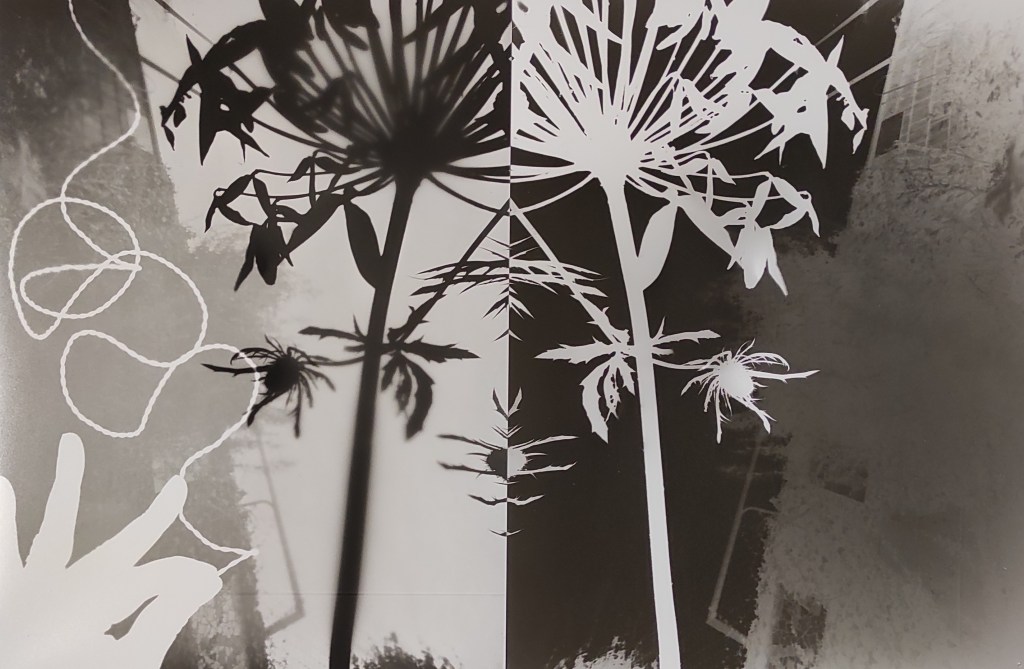
Elizabeth Ransom: You begin to experiment with your pinhole photography by adding agapanthus within your pinhole cameras, playing with cyanotypes, and exploring lumen printing. Can you talk us through some of these explorations and why you chose to work with these processes?
Wendy Leocque: I enjoy the creative freedom I have within analogue photography. Once you are familiar with the processes and techniques, you can then break the rules and experiment. I understand well how to take a photograph and for this project I have essentially built my own camera. The ownership that gives you is quite freeing. Expanding on this by exploring these techniques further, pushing boundaries, layering to add texture and optical interest gives me a creative freedom I don’t think I can get any other way. With my ‘garden’ image. My starting point was, again, to connect with my grandmother through her love of gardening. I went to my community garden a couple of times to take the image, but both times it was quite a windy day, which led to a muddy final image due to the plants swaying around during long exposures. On my next attempt, I placed a dried agapanthus head inside the pinhole camera, which was a gift from my grandmother when I moved house. This created an in-camera photogram and became an anchor, a point of interest. The blurred photograph from outside, taken during exposure, added texture. After I developed the paper negative, I did what I always do, which is to contact print the positive. The only difference with this image is I began placing things on top of the exposure, my hand and tether to represent the ongoing connection to my grandmother. The result provided an additional photogram created under the enlarger. I like to display the negative and positive side-by-side creating symmetry, it is reminiscent of a Rorschach ink blot, the viewer is then invited to interpret how they see the image.
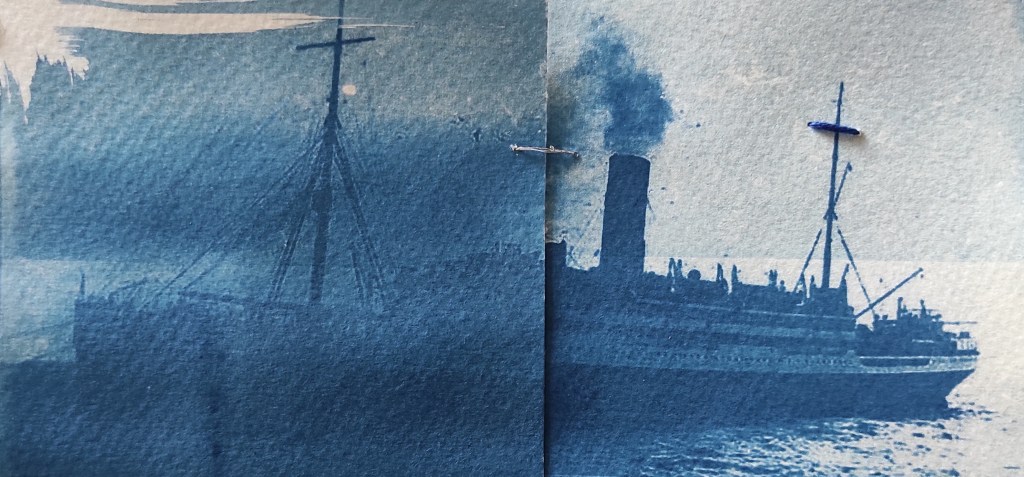
Analogue photography is how I was taught when I did my photography degree, which is over 30 years ago now. I enjoy the tactile quality of these techniques. I really like the reaction to the possibilities of experimentation and the fascination that it produces. I have taught a lot of traditional and alternative techniques and while I was facilitating some Windrush workshops, these alternative processes were a natural fit. I decided to incorporate cyanotype, chemigram and lumen printing because they’re so accessible and lend themselves to group participation over a few hours or a day workshop. With the cyanotype process I produce black and white Windrush photocopy negatives, which kept things quite cost effective for these workshops. Photocopy negatives also gave me the ability to use easily recognisable visual imagery to teach the content. Stitching into my cyanotypes developed later and was inspired by various artists using this technique. My ‘Other Country’ and ‘Orbita’ cyanotypes incorporate codes [ciphers] to look out for. Examples of this show up in ‘Other Country’, depicting the Windrush generation being sold a myth, invited to what they believed was their mother country, only to find this was not the case at all, the cross stiches reduces it to ‘other’. Two simple stiches on my cyanotype of the SS Orbita, refers to the Conquistadors arriving to the shores of the Caribbean, disguised as do-gooders, selling their brand of religion and eventually completely decimating the indigenous population.
For total freedom chemigram printing ensures you abandon any preconceived ideas of what you want your end result to be, in favour of what the process will gift you. While lumen printing for me gives honesty, reflecting the transience of life itself. I have heard artists refer to lumen prints being like capturing the breath of the subject, as its usually some organic matter that will work best for this process, like a leaf or flower and since I don’t fix my lumen prints, they will disappear over time. My exploration into the process led to my pyrolumens experiments, which were created by playing and asking ‘what if’, the light and heat from a flame can create its own image. I continue to use all these techniques to tell the story of Windrush and experiment with different ways to tell it. Even my direct and straight pinhole photographs have taken a more abstract quality. I do this by photographing partial aspects of an artifact, as I want something that hints at an object, rather than tells the whole story. I enjoy the way the viewer interacts with an image, by perhaps trying to work out what it is, and essentially its the feelings the viewer is left with after the encounter.
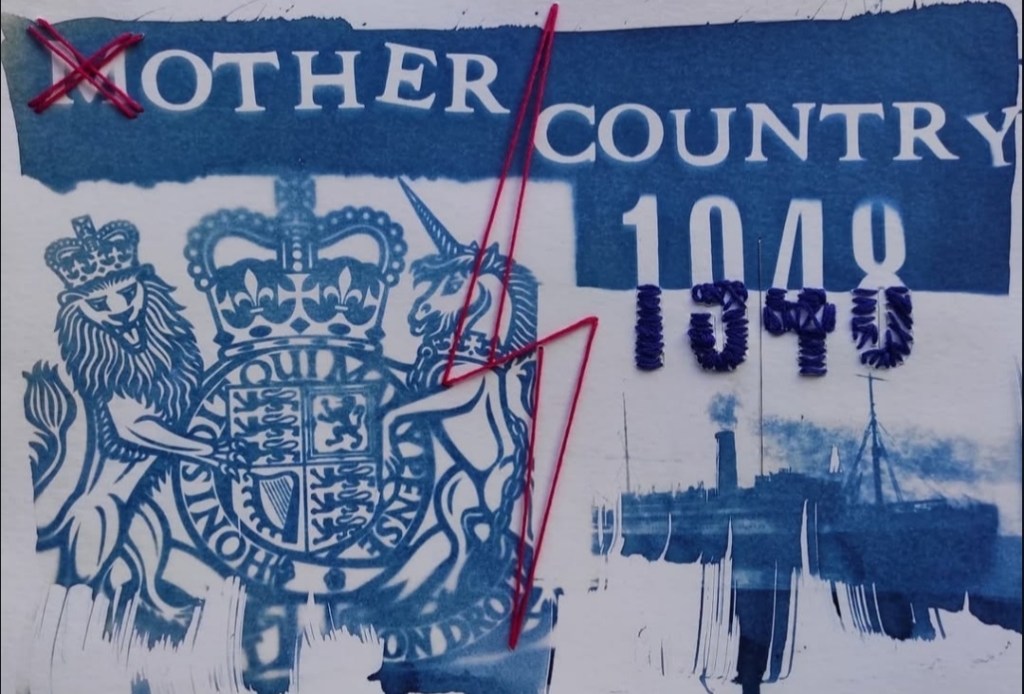
Elizabeth Ransom: For those who are unaware of the Windrush Scandal, in 2010 the UK government destroyed landing cards belonging to the Windrush generation and many were asked to prove they had a right to stay. Devastatingly, people were deported, detained, and denied legal rights such as access to healthcare, work and housing. Families were separated and livelihoods lost. What is the ongoing impact of this scandal and what do you want people to take away from your work?
Wendy Leocque: The ongoing impact reaches much further than the loss of housing, jobs and material things. This impacts a sense of belonging. Many of the Windrush generation felt British before they arrived in the UK. Being British subjects in a British colony meant that their assimilation started long before Windrush. My grandmother arrived in the UK on her British passport, which also shows up in my work, and reflects on passport hierarchy and temporary status, through the anthotypes created within the pages.
When the Windrush scandal finally broke in 2017, it was the cumulative effect of the destruction of the landing cards in 2010 and a new piece of legislation known as ‘the hostile environment’ in 2012, which resulted in the scandal. The purpose of this new legislation was to make life as difficult as possible for immigrants without leave to remain, and as the ID checks increased, the Windrush generation, who had the right to remain, were wrongly classified as illegal citizens, they began losing their jobs, housing, access to the NHS, which many had worked in for so many years. Some were held in detention centres until they could be deported and refused the right to return. As of today, not everyone has received compensation. People who were wrongly deported died fighting this injustice and lost everything they had worked so hard for. The Windrush compensation scheme is one of the few major state schemes that doesn’t provide legal assistance and the Home Office has so far rejected calls to do so. All of this was taking place at a time British taxpayers made their final payment in 2015, to the descendants of former slave owners, which included taxes from my grandmother and the Windrush generation. We are talking about the ‘Slave compensation Act’ of 1837, being paid by the descendants of the enslaved. Generational wealth has been amassed through family inheritance from the 46,000 British slave owners to compensate for loss of property. The enslaved received no such compensation and the Windrush generation and their descendants continue to fight for recognition from a country they literally broke their backs to build.
To date many are still being threatened with deportation, even though in 2018, on the 70th anniversary of Windrush, the issue was finally raised in Parliament, and a formal apology was made by the government. It seems particularly aggravating to continue to threaten people from this group with stripping them of their British citizenship, rather than concentrating on fulfilling the apology to those who have been wrongfully accused. This scandal also effects the children [and potentially grandchildren] born in the UK to Windrush parents with having their British status revoked. The impact is immense and it continues. What is being perpetuated by all of this? The UK has been made richer in all aspects by this migration, but there is an effort by government policy to rid itself of the very people who made these things possible. Whole countries and nations were made to forget their own language and heritage. Countries were ruled under the same political system and education, nations were taught someone else’s history and literature before their own. The assimilation was far reaching, and is as deep as it is wide. For the Windrush generation there was a connection to a ‘Motherland’ that they were so proud to be part of, which went on for centuries. They were dutiful children of empire. Today, many of the Windrush descendants feel anchorless, perhaps that is the point, the hostile environment, a piece of government legislation brought about to make certain sections of society feel as though they don’t belong, this appears to be the system working perfectly as planned. In this sense the suitcase holds the most powerful symbol, what do you do when you no longer feel like you belong? Do you move? Where do you go? To a place you’ve never known? What do you take with you and what will you leave behind? The empty suitcase is a perfect symbol to pose these questions, referencing the nomadic push, pull and starting over again from small beginnings. My project is a reminder of what the Windrush generation sacrificed and through these artifacts and what they represent, there is a reminder of what they brought to the UK. This project is a contribution to the many Windrush stories and ongoing debates around this shared history.
For more information about Wendy Leocque and her practice please visit her Instagram HERE.


Leave a Reply