21 September 2026
Interviewed by: Elizabeth Ransom
Trigger warning: Mention of pregnancy loss and fertility concerns
Visual artist Melanie King offers a glimpse into her journey to motherhood through the use of the cyanotype process. Snapshots of waiting rooms, flower bouquets, ultrasounds, and medical tests are rendered in Prussian blue, providing evidence of the enduring experience of becoming a mother after pregnancy loss. This powerful body of work acts not only as a form of healing for the artist, but also aims to raise awareness for pregnancy loss, subfertility and infertility.
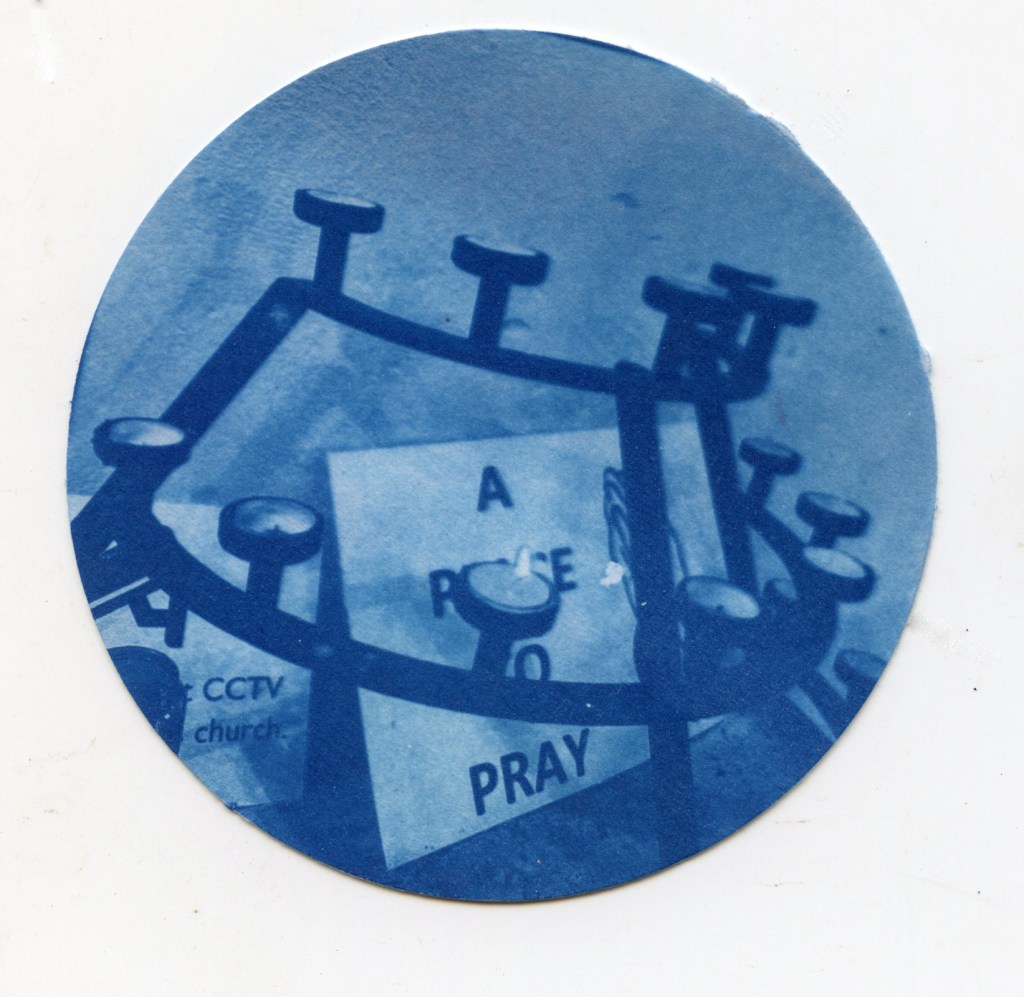
A place to pray, Cyanotype
Elizabeth Ransom: In your new body of work Matrescence you use your own personal experience of becoming a mother to address issues of subfertility, infertility, and pregnancy loss. This is something many who view your work will be able to connect with. According to the American College of Obstetricians & Gynecologists early pregnancy loss can occur in 10 percent of known pregnancies [1] Can you tell us a little bit about how your own experience inspired this project?
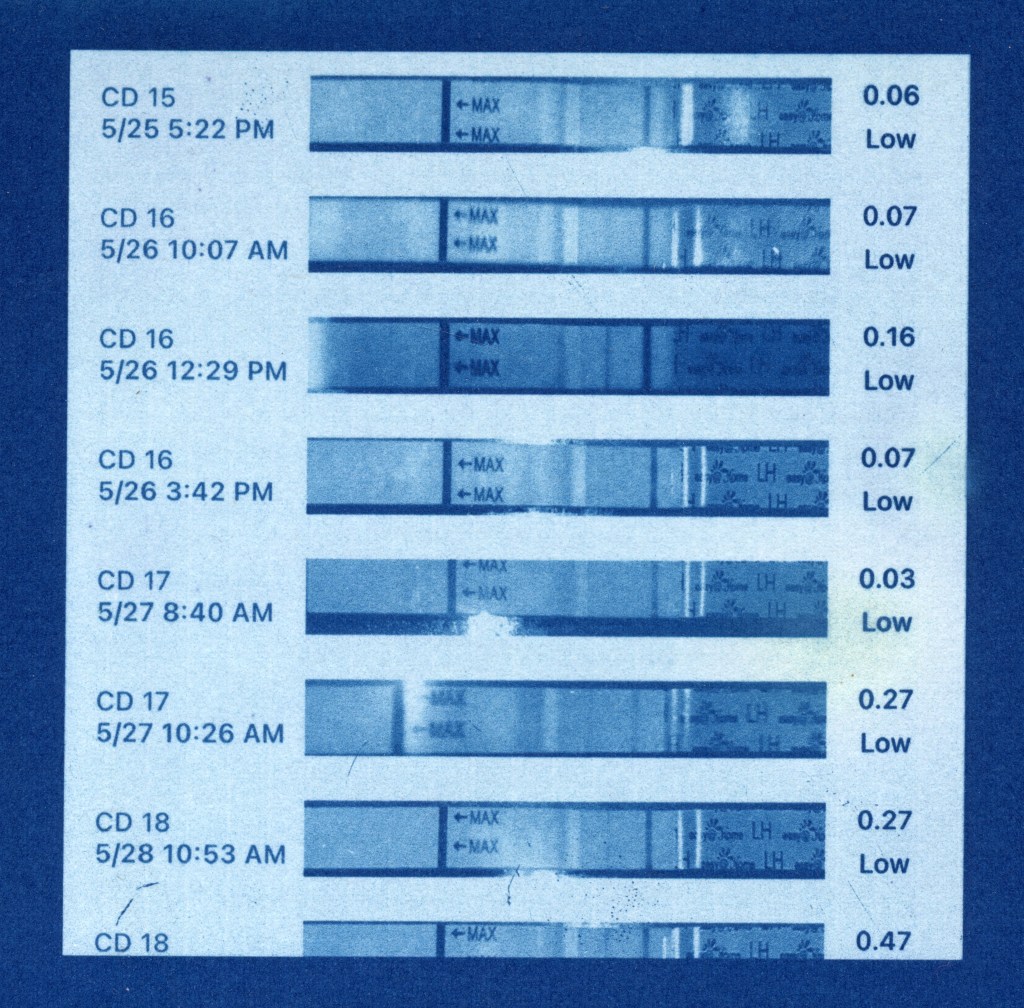
Melanie King: Matrescence documents my difficult journey to becoming a mother, including subfertility and pregnancy loss. The images from the project are vignettes of my experience, an accidental archive built up whilst attending appointments and medical procedures, poignant memories that I felt compelled to hold.
In April 2023 I became pregnant just after my marriage to my husband Sam. I was very happy and couldn’t believe my luck. In June 2023, I had a 14 week scan booked and decided to book a private 12 week scan, just in case. For one moment, me and Sam were really happy as we could see the babies heartbeat but our hopes were dashed almost immediately. The sonographer looked very concerned and could see that the baby hadn’t formed properly – the baby had no nose bone and had severe problems with the heart. Fast forward one week and we were fast tracked for an NHS scan in London by the fetal medicine team. There, a highly experienced sonographer confirmed that our baby had problems not compatible with life, would probably not live until full term or would die shortly after birth. So, at 14 weeks pregnant, I had what is called a ‘Termination For Medical Reasons’ and agreed to labour so that a postmortem could be conducted on the baby. This was incredibly traumatic as the midwife left me for a live birth, and only had my husband for company when my baby was born. This has made me advocate for myself in situations following this experience.
I got to see my baby and was so glad I did, as he had beautiful features – like perfect fingernails and ears. Even though he was so small and he wouldn’t have lived for a long time, he was still so amazing to look at. We attended a group funeral for our baby, where other ‘loss parents’ gathered to say goodbye to their babies. Our post mortem then came back and it was found that our baby had patau syndrome, which is rarely survivable.
Once we found out the cause of our pregnancy loss, we decided to take time to heal, and then try again. I then had a series of chemical pregnancies which Tommy’s describes as ‘a very early pregnancy loss, which usually happens by 5 weeks. A pregnancy test detects an increase in pregnancy hormones, but the embryo is lost before it can be seen on an ultrasound scan’. For me, this included strong pregnancy symptoms, a very late period and an extremely heavy period when it came. One of these happened while I was giving a talk, and I felt myself lose the baby. In January 2024, I did a walking challenge and raised £1500 for Tommy’s, an amazing charity which supports many through pregnancy and loss. This was the first time I publicly discussed my losses and was overwhelmed by messages of people who had been through similar experiences. I knew then that I wanted to start a project which brought the subject of pregnancy loss into conversation. Often pregnancy loss has been a taboo subject, and this has meant many people have suffered in silence.
In April 2024, I became pregnant again, this time I was reserved but hopeful. I decided not to have a scan as I thought it would cause excess anxiety. Then, while I was at an event at 10 weeks pregnant, I saw blood and decided to get a private scan again. Sadly, an ultrasound showed that the baby had stopped growing at 6 weeks, and that I was experienced what is called a ‘missed miscarriage’. I had PTSD symptoms around this time and was able to access NHS counselling which has been transformative. I am sure that the counselling I have received has allowed me to process the feelings sufficiently so that I can talk about my experience without getting upset.
Following the missed miscarriage, my husband and I were referred to the NHS Fertility Clinic and we underwent many tests. In January 2025, I signed up to the Worst Girl Gang Ever 10k for 10k running challenge, raised £500 and made a podcast with WGGE about my experience. https://open.spotify.com/episode/2ftjcau0AlJNUjTOQfdAfn
The Worst Girl Gang Ever are a charity who provide different types of support for many areas of baby loss. They have books, podcasts, seminars, courses and whatsapp groups for different types of loss, stages of pregnancy and for parenting after a loss. I’m still part of some of the ‘rainbow parents’ groups! Alongside the running challenge I took a WGGE course called ‘Trying to Conceive After Loss’ which gave me lots of useful information about fertility, and it is here I came across Rachel Sheriff from The Fertility Suite. I began further tests with her alongside the NHS clinic. I had ovary stimulating medicine, progesterone, supplements and acupuncture. I exercised regularly, had an improved diet and removed plastic and toxins where possible. Around this time, I realised that a lot of my fertility research had crossovers with my sustainable photography work – for example, eliminating toxic chemicals to purify waterways, harnessing plant phenols, aiming to eliminate plastic use etc.
In July 2025, I became pregnant again and this time I threw everything I possibly could at my pregnancy. I didn’t want to leave a thing to chance! Due to my previous experiences, I had specialist bereavement midwives who looked after me with appointments most weeks, continued with my counselling and had early scan/doppler checks. I also had private scans and as a result, I now have a big multimedia library of scan imagery! In April 2026, I welcomed my baby boy Max who is now 5 months old. I chose to have Max by C-section because I wanted to eliminate the chance of complications, and apparently this is very common in mothers who have had pregnancy losses.
Now that Max is here, I feel ready to focus on this project. I am passionate about sharing experiences of pregnancy loss and subfertility, as the statistic says, it is experienced by so many. Some things I have shared may seem like ‘too much’ to share, but these are real experiences that many parents go through without anyone ever knowing. I would like to live in a world where talking about pregnancy loss and grief is more commonplace.
There are three books I found very useful during this time;
The Worst Girl Gang Ever: A Survival Guide for Navigating Miscarriage and Pregnancy Loss by Laura Buckinham and Bex Gunn. This book shares many stories of people who have had pregnancy losses, whilst also sharing information about how to deal with certain situations – such as navigating a friend who announces a pregnancy.
Adrift: Fieldnotes from Almost-Motherhood by Miranda Ward. In this book, Ward discusses the tensions that arise when suffering from infertility and loss. For example, I found it very hard to plan ahead so I felt that my career suffered. I cancelled residencies and workshops whilst pregnant and then found myself in a place where I was then not pregnant and also without these career opportunities. This happened multiple times with several pregnancies.
Matrescence: On the Metamorphosis of Pregnancy, Childbirth and Motherhood by Lucy Jones. Lucy Jones discusses some of the scientific aspects of pregnancy which really helped me to understand more about what was happening to me physically. She discussed how our brain changes even in early pregnancy, how my brain was primed for motherhood by nature, with no baby to mother. I also took comfort in microchimerism – where a babies DNA can be found in many different parts of the body – so even though I have lost my children they are still physically part of me. In addition to this, their DNA also can be found in subsequent children, so Max physically connects me to the babies I have lost.
On my website, I’m putting together a resource list so that in addition to looking at my project, there are links and organisations that I have found useful.
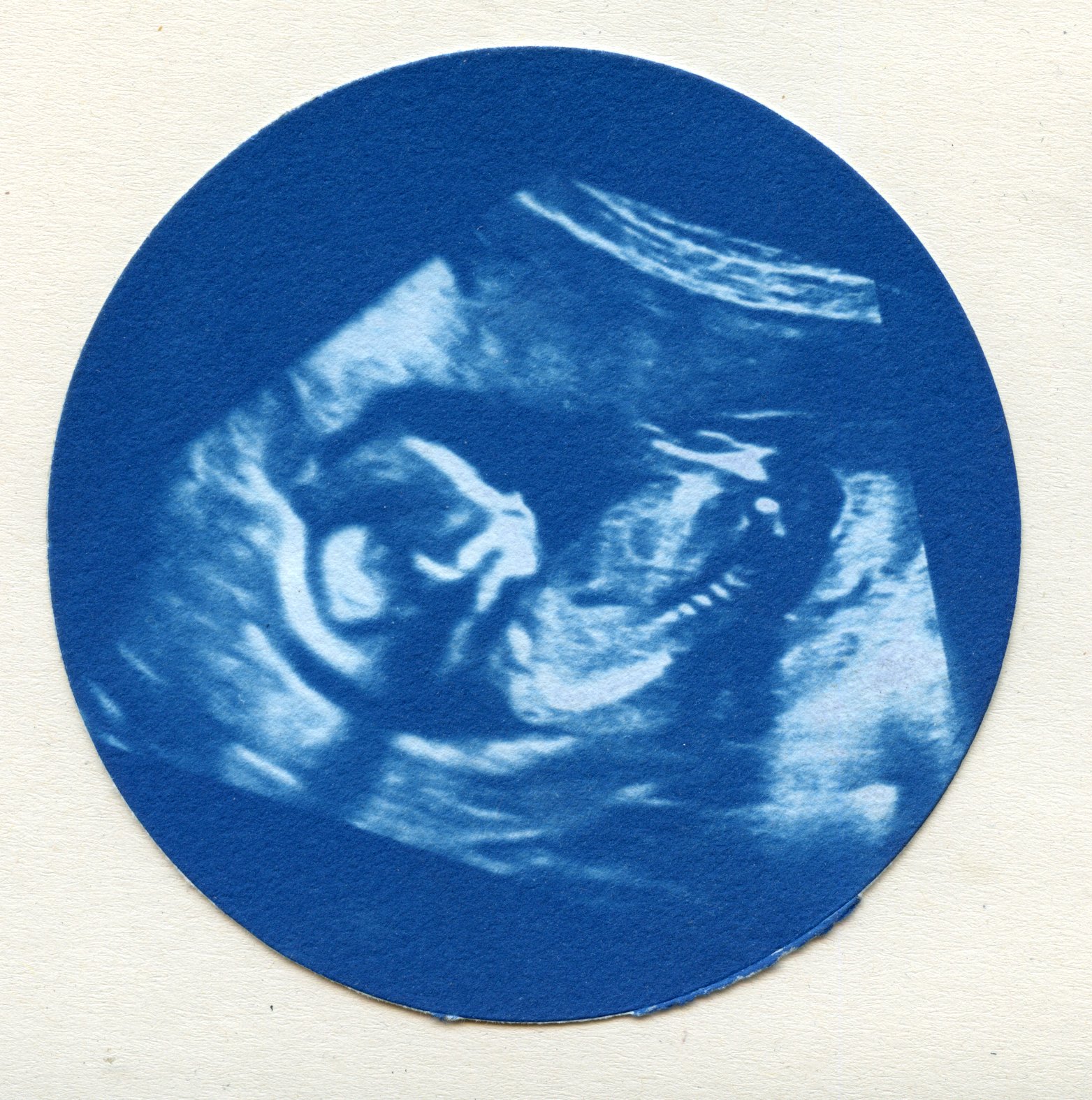
Max, Cyanotype
Elizabeth Ransom: What was it like for you to explore such a vulnerable personal story in your work and how are you using alternative photographic processes to aid in self-repair?
Melanie King: I took the photographs from this project without thinking about it and have since realised that I am obsessed with recording things. I write every day and take photographs obsessively. I believe that the act of photography in these moments enabled me to cope, a way to pass the time and to process what was happening to me.
‘Art, like crying, is an act of self-repair, to shed the natural tears that free us, make us strong.’ Helen Chadwick.
As the photographs were originally iPhone snaps, I collected the images for the project together and made them into negatives. This Summer, I made the cyanotypes in my studio, using sunlight from outside my studio door. I then utilized a large hole punch to make the images a circular shape, which I feel add to the intimacy of the viewing experience whilst also creating a physical ‘vignette’.
As my images emerged from the water, I felt quite emotional. I had the feeling of ‘yes, this really happened to you’ and felt the gravity of what I had been through. I had tried not to ruminate too much over my past losses during my pregnancy with Max, as I thought it could cause unnecessary stress. However, once Max had arrived safely, I felt ready to start working on the project.
It may sound macabre to work on a project about baby loss whilst looking after my new baby. Conversely, I think that working on the project helps me to appreciate Max more. Motherhood is difficult but I know that I am very lucky to have a child. Going through fertility treatment does not guarantee a child, and some people are so devastated from pregnancy loss that they are too heartbroken to try again. I have included images from my pregnancy with Max as I think it’s important to document my overall journey to motherhood.
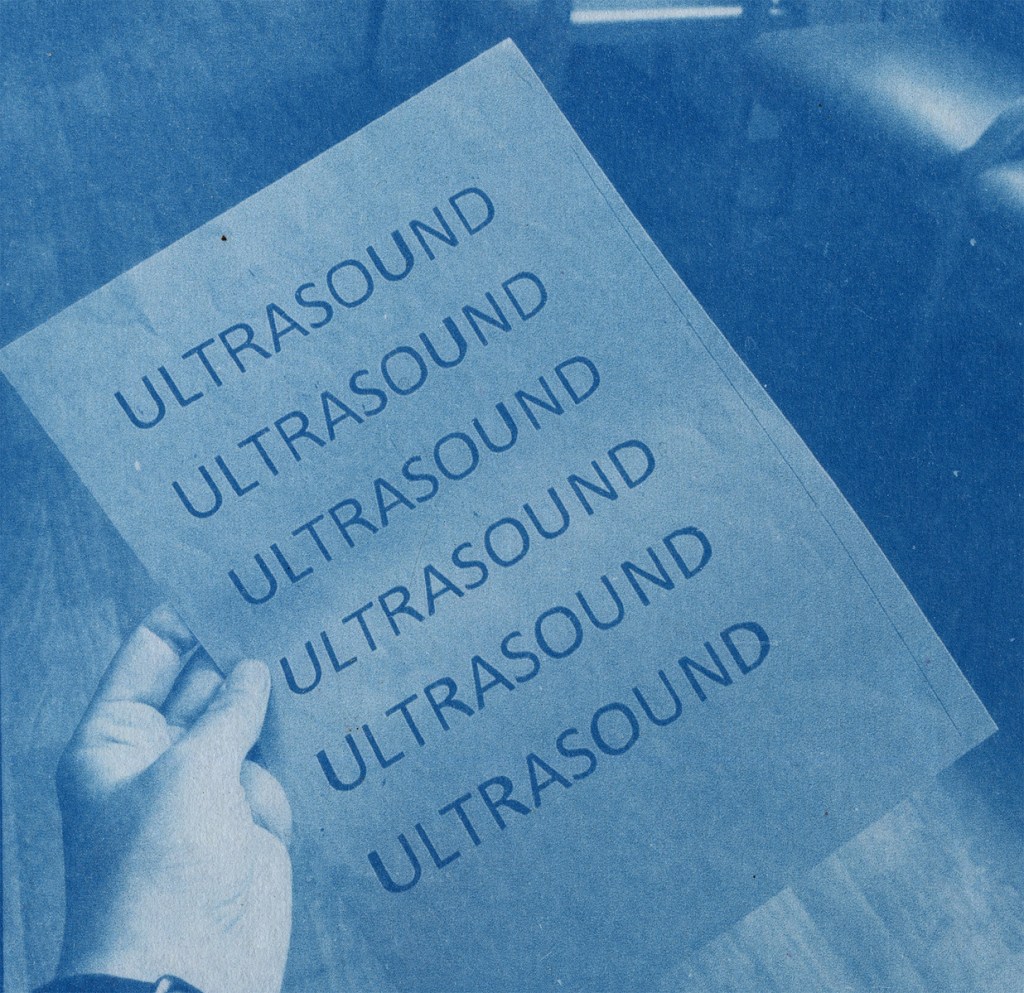
Ultrasound, Cyanotype
Elizabeth Ransom: The images within this work document healthcare waiting rooms, doctor’s offices, test results and ultrasounds; vignettes of your experience of grief and your transformation into motherhood. What drew you to the cyanotype process to visualize this experience?
Melanie King: I am very comfortable with cyanotype, as I have been working with the process since 2010. Making cyanotypes is second nature, and there are endless ways to experiment with it – in previous projects I have worked with cyanotype toning and duotone layering. I wanted the process to be simple and enjoyable as the subject is quite heavy. Also, as a new mother and sustainable photography practitioner, I want to work with low-toxicity chemistry so that I do not inadvertently bring harmful chemicals close to my child.
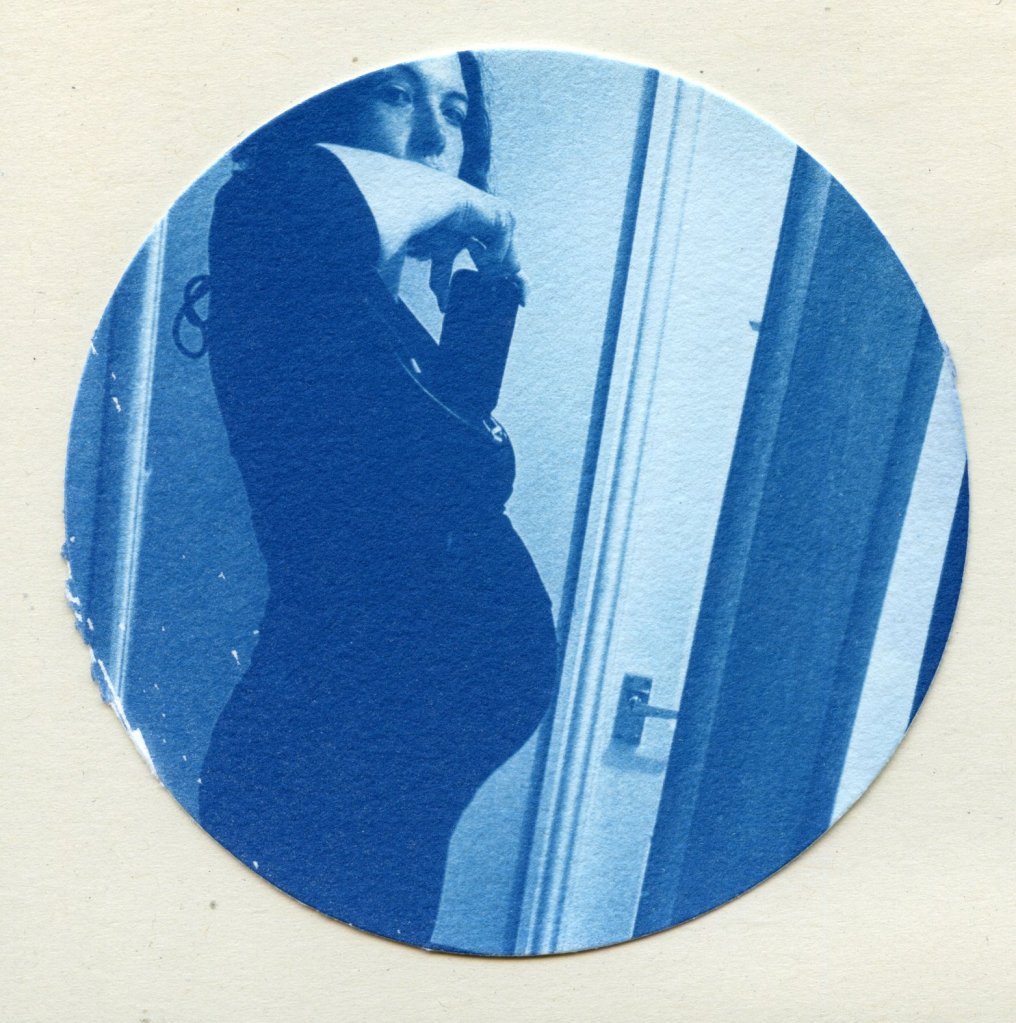
Self Portrait: Pregnant with Max, Cyanotype
Elizabeth Ransom: Given the stigma, misinformation, and often silence surrounding pregnancy loss, subfertility and infertility, how do you hope this body of work will impact public conversation?
Melanie King: There are several artworks which discuss subfertility, loss and infertility – bringing them into conversation. I wanted to add my story to this field, in my own way. I strongly feel that the more people share their stories, the less stigma will be attached to pregnancy loss. I know from talking very publicly about my experience whilst fundraising, that my story resonated with many people and made them feel less alone. Some people have lived with their stories in silence for decades because it was even less commonplace to discuss loss back then. This hiding of experience can negatively affect the sufferer, and people around them know that something is wrong but do not know the reason. This can cause tension and misunderstanding. I would ultimately like to provide spaces with the work where people can share their stories and commemorate their lost babies. In future, I aim to lead alternative photography workshops where people can make a print to commemorate their baby. I think it’s important to have a physical object to look at and hold that can connect you to a child that has died, at whatever stage of gestation. I have taken comfort from tiny foot and handprints, a bear that was with my first baby in his cold cot, and my ultrasound pictures. These all help me to validate my experience and feel a physical connection to the children I have lost.
Elizabeth Ransom: While this work is deeply personal, it also addresses greater political issues concerning fertility and reproductive health. In the US, for example, there has been a decline in access to care. Many reproductive health programs have been dismantled and rising costs in health insurance create economic barriers for treatment. In the UK there are record long NHS gynaecological wait lists and severe shortages of mental health support for those impacted by pregnancy loss. What role do you think personal stories can play in humanizing political issues such as access to care and women’s reproductive health?
Melanie King: Whilst going through my losses, I have been devasted to hear of abortions and pregnancy losses being criminalised. In some states, I would not have been able to have my termination for medical reasons for a baby that was sure to die, either in pregnancy or shortly after birth. I cannot fathom how a woman is meant to cope with such an experience, in addition to the threat of being prosecuted – or to carry a baby to term only to lose the baby shortly after. Not only is this traumatic, but it is also dangerous as women can have serious pregnancy or birth complications with a child that is essentially very ill. As you can probably tell, I am pro-choice, and firmly believe that a woman should decide what is right for her.
In relation to the UK, I feel that the NHS is underfunded and this is having a substantial impact on maternity care. Midwives are paid very low wages, and have to deal with some very difficult experiences – made worse by midwife shortages. Not only is this stressful for staff it also impacts on the patients experience. I had to lose 5 babies and have 2 surgeries before I had specialist care. I was also not eligible for IVF on the NHS because my pregnancies counted as ‘conception’.
Ultimately the more we discuss injustices around pregnancy and fertility, the more we can fight for women’s reproductive health and care. We help no-one by staying silent.
For more information about Melanie King and her practice please visit her website HERE.
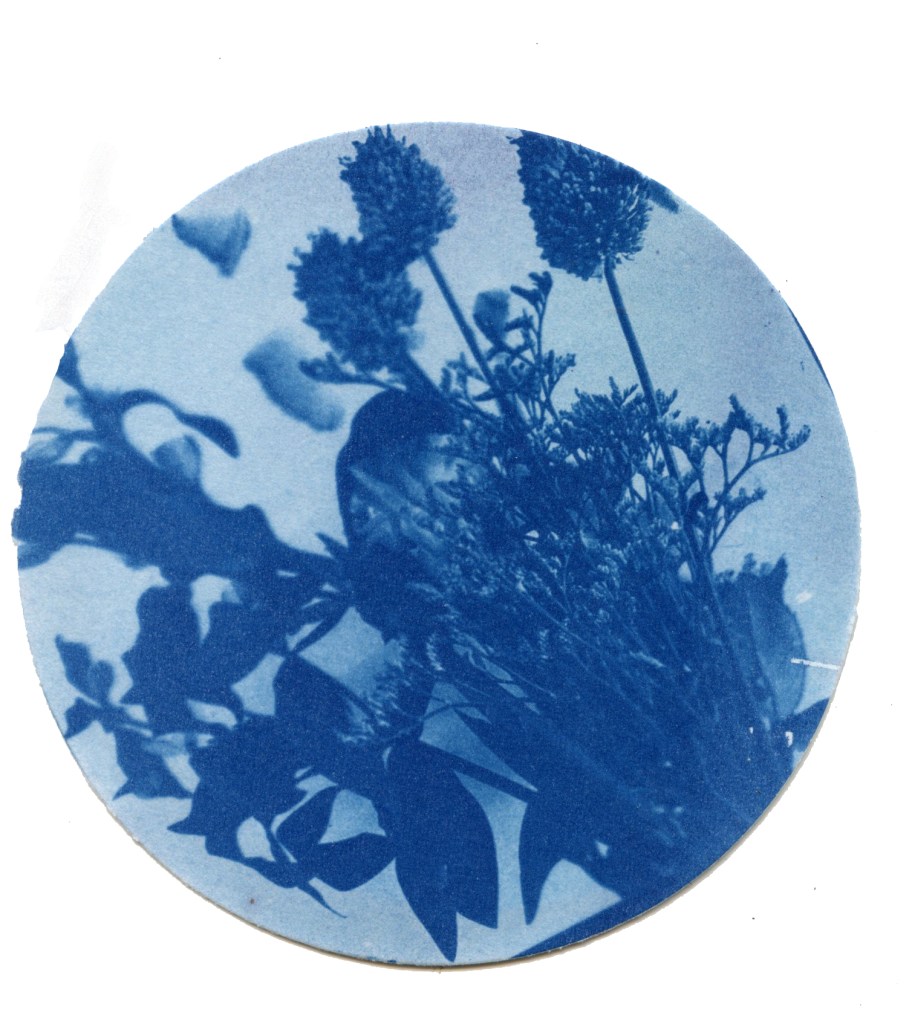
Flowers, Cyanotype
[1] https://www.acog.org/womens-health/faqs/early-pregnancy-loss


Leave a Reply