
27 August 2026
Interviewed by: Elizabeth Ransom
Founder of The New Somatic Photographic (NSP), Rhona Eve Clews shares her philosophy behind her non-hierarchical framework for photography. Rhona’s work is inspired by science fiction, ecofeminism, spirituality and the natural world. She wraps herself in 16mm film, crawls amongst pollen and insects, and collaborates with nature. Within her own practice and The New Somatic Photographic, Rhona aims to explore how photography is relational and co-authored.
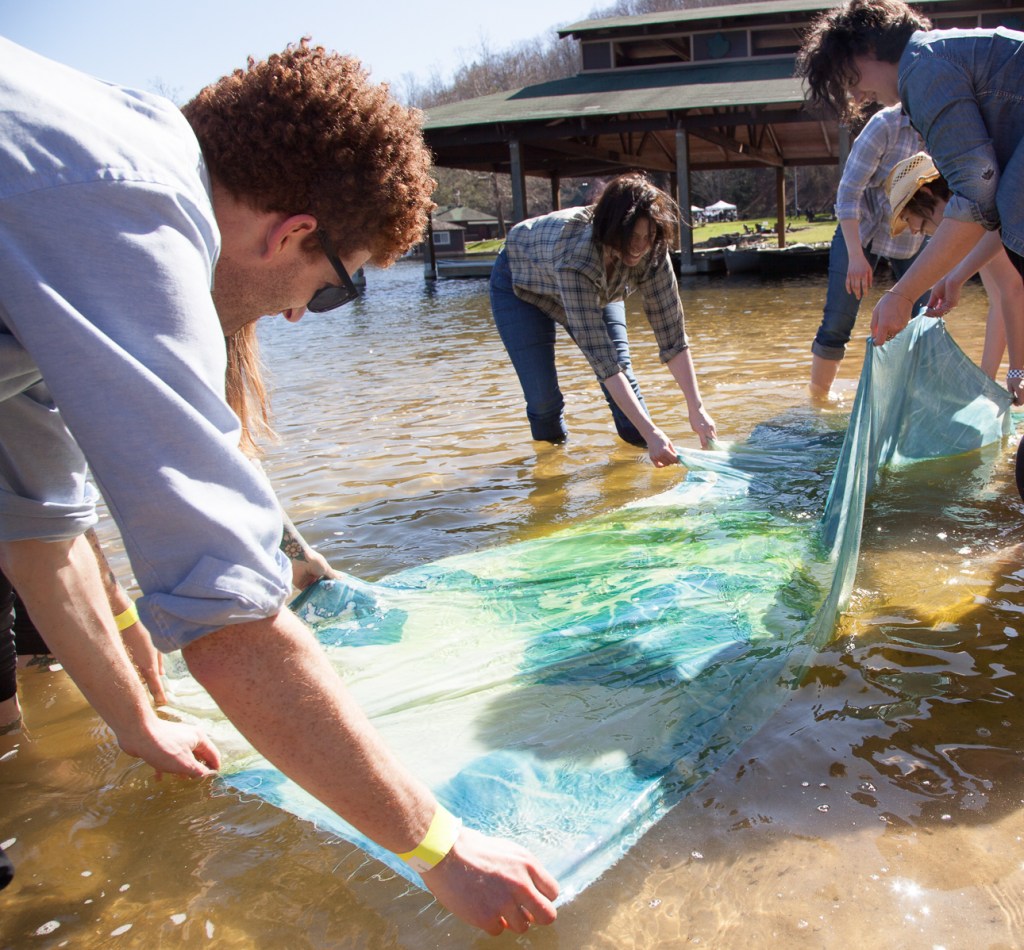
Rituals for visual listening, Black Mountain College (2018)
Elizabeth Ransom: You have founded the ecofeminist framework titled: The New Somatic Photographic (NSP). This idea “acknowledges photography as interdisciplinary, sensual, embodied and located within the more-than-human. Where analogue film and photographic materials are approached as participants within wider ecological systems” (Clews, 2026). Can you share with us how this idea came to be, the inspiration behind this framework, and how you incorporate these philosophies within your own creative practice?
Rhona Eve Clews: Yes, on reflection I can see The New Somatic Photographic was birthed about ten years ago. I was living in Aotearoa New Zealand and had a solo show called Land and Sound (2015) at the Audio Foundation, Auckland, exploring the interconnectedness of creativity and ecology in those islands. I was talking with an experimental musician and photographer who had found themselves prioritising music because musicians ‘jam’ together, within a culture of improvisation, collaboration and exchange. That opened up a bigger conversation about the lack of equivalent spaces within photography, with its typically singular authorship and clear hierarchies.
I had come from working in photo labs in the 1990s, where photography felt exciting, but definitely separatist — often an intruder to the wider ‘art’ party. I’m inspired by the fluidity of Black Mountain College, with a typical student day moving through dance, painting, drawing, gardening, swimming, etc. The NSP is my desire to help ‘mother hen’ photography back into that fold! Situating image-making as relational, co-authored, embodied, more-than-human exchange suggests that the camera, darkroom and light-sensitive materials might be approached as participants, with interrelationship itself becoming a site of potent generation.
From 2011–2017 I developed a series of what I call Seanotypes -cyanotypes made with flotsam, jetsam and seawater in multiple oceans. I’m a sci-fi fan and was thinking about Stanisław Lem’s Solaris, which explores an oceanic planet’s capacity for consciousness, and I was asking myself similar questions around environmental philosophy and the natural world. Variations in salt content meant each watery body created different results, with images continuing to transform long after the paper had dried. This co-creative practice felt like a direct challenge to the colonial cliché of a solitary author/hero dominating the landscape!
In my own practice, the NSP might look like collapsing the gap between my body, materials and land, trying to climb ‘inside’ materials or queering technologies. In The Body Keeps the Score (2018), I wrapped raw 16mm film around my limbs in darkness and exposed it by matchlight. Pressing myself into the material, the emulsion holds traces of hair and skin, with boundaries between body/film becoming indistinguishable. In Heatwave (2020), I pressed my body and a stolen lily pad directly against a scanner; flesh and plant soften and smear into one another, refusing fixed ideas of the ‘natural’ and the ‘feminine’.
The NSP comfortably dialogues with queer ecology, phytocrip theory, intersectional feminism, hydrofeminism, eco-phenomenology, eco-somatic practice and the sustainable darkroom — amongst others!
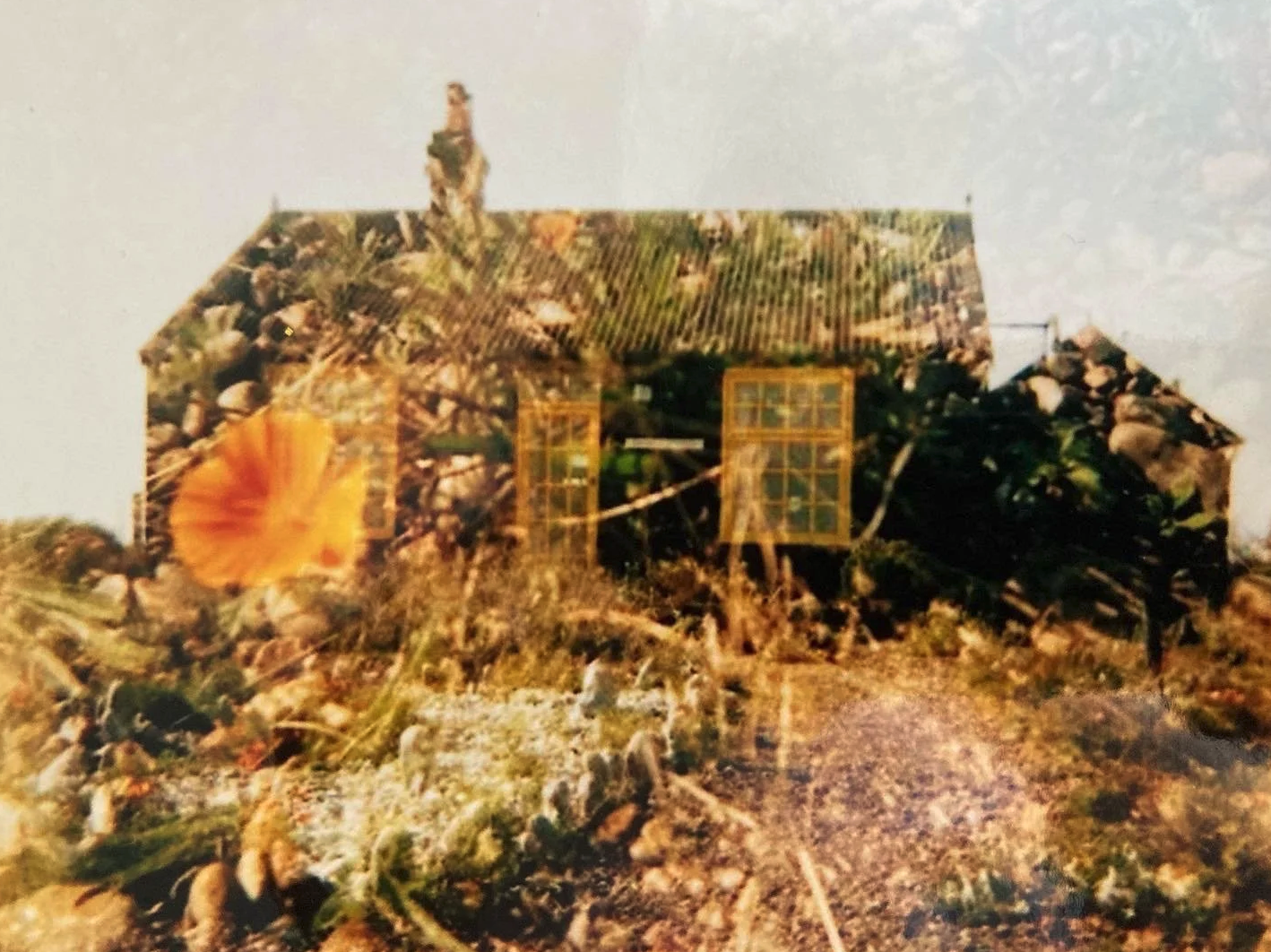
Californian poppy Prospect (2012)
Elizabeth Ransom: Building upon ecofeminist ideas and human relationships to the land, many of your artworks could be seen as a dance with nature. Could you tell us a little bit about the more performative elements of your work?
Rhona Eve Clews: In my interview for the Slade I described myself as “a performance artist in hiding”, and I still think that’s true! Even when the outcome is a photograph or roll of film, the performance usually comes first.
A lot of this developed in Dungeness. Growing up in the low hum of 1990s
Maidstone, my friends and I formed an island of queer artists to cope, with Derek Jarman as our hero! A decade later, my then-partner’s family moved two doors down from Prospect Cottage. I developed rhythms of making photographs by day and walking the ness at night, filming the moon.
As a woman I’d learnt that darkness wasn’t somewhere I was supposed to occupy, and from 2012 I began a decade-long enquiry into reclaiming night. Without sight, every other sense became louder; the process instinctive, sensual and exhilarating. Darkness became a cloak, giving me permission. I felt akin to the latent image in a photograph: I was there, but no-one could see me…yet!
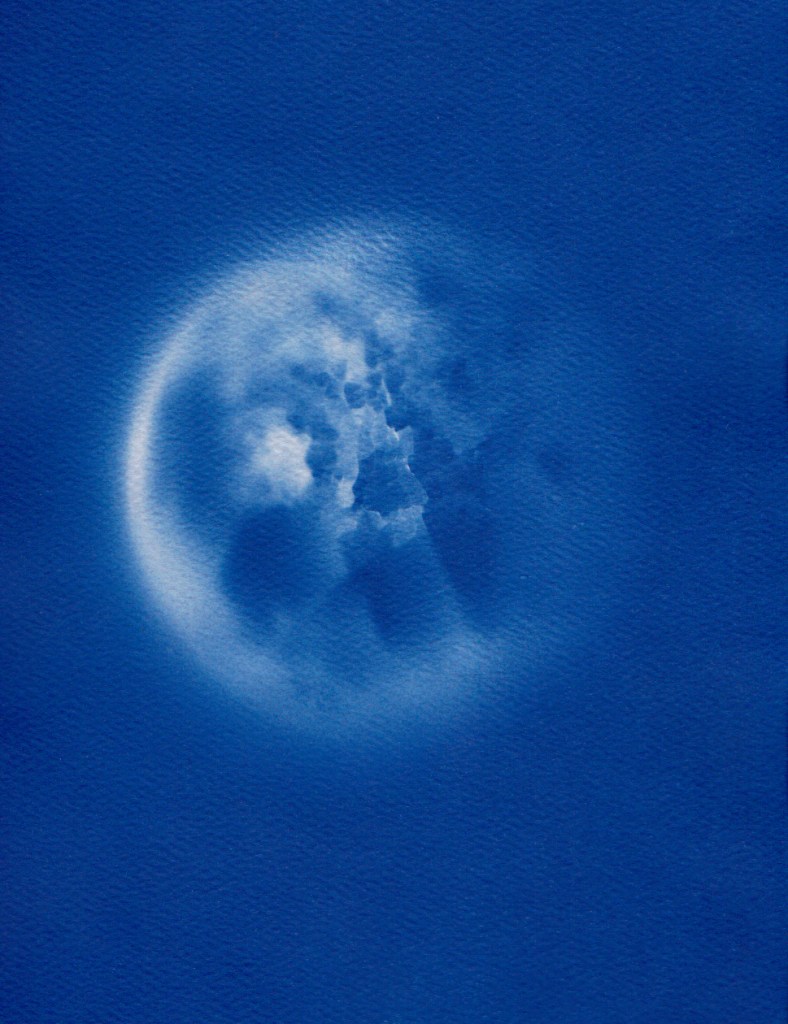
I made photograms at night in Jarman’s garden, fantasising that I could pick up his auric trace in the psychic field of his plants. Alongside art I’ve worked as a healing practitioner for 20+ years, making me highly attuned to invisible fields! I also queered photographic technologies, turning a found glass lens into the moon with children’s Sunprint paper and working across still and moving-image.
This experiential knowledge later travelled with me to a forest regenerating from bushfires on an art residency in Australia, making fire exposures of photographic paper at night. Developing in my darkroom, I found images I didn’t recognise: charcoal from the bark had rubbed directly onto the paper. The photographs felt like relics of encounter.
One won the London Alternative Photography Collective Alternative Processes Award (2016), but the relics also frustrated me, they couldn’t hold the collaborative journey of their making. At the Slade, bringing photography, writing, film and performance together was liberatory; humour and absurdity suddenly had room to exist!
During my MFA I created Rituals for Visual Listening (2018) with Black Mountain College Museum and The Asheville Darkroom: public performances making photographs with lakes, woodland and firelight. Performance is already a huge part of photography: the choreography of the darkroom and the interrelationship between light, body, material and technology. For me, foregrounding that process reveals the psychic and physical relationships I feel with land and materials. The photograph
might be the potent relic or portal, but performance can pull somebody into the encounter that produced it.
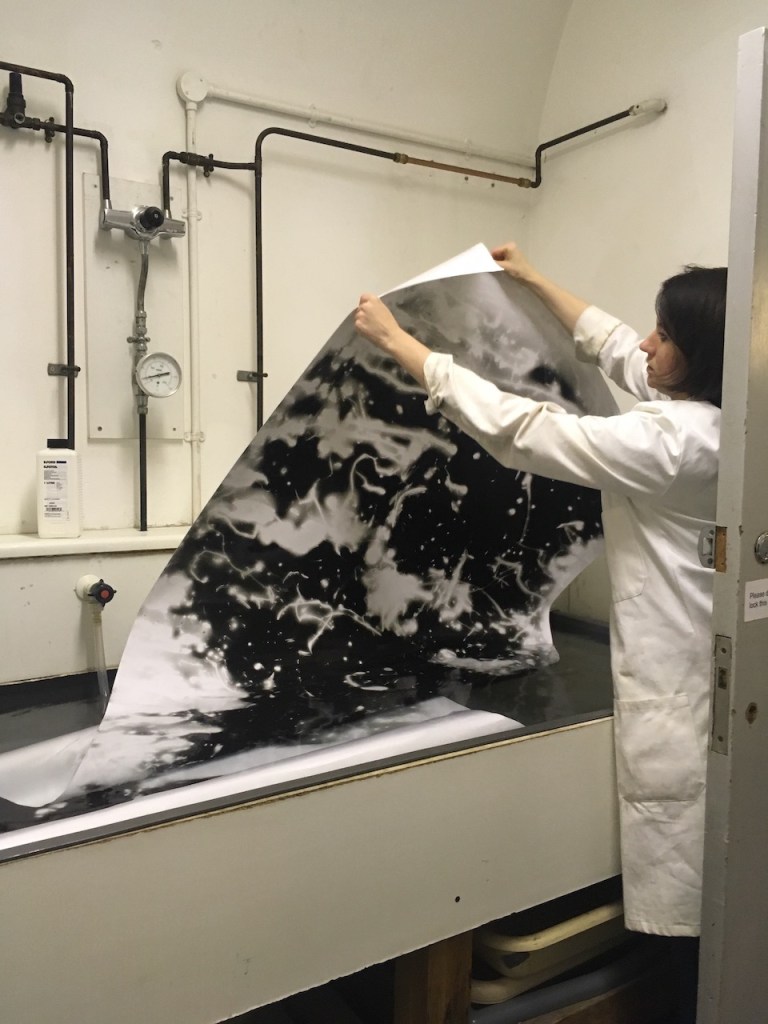
Mother Night (2017-2018) Image of Rhona Eve Clews and photographed by Elena Andreea Teleaga
Elizabeth Ransom: Experimentation and play are instrumental to the creation of your photographic practice. How do the materials you use such as scanners, Polaroids, and moving image influence the playfulness of your work?
Rhona Eve Clews: I think this is really about curiosity, and a willingness to gad about and look stupid! Each material teaches me to think differently, and play is often a way of finding out what it knows that I don’t, which is the gold of any relationship!
When photography became digital by default, I found myself unexpectedly grieving analogue film. With analogue, the gap between making the photograph and seeing it gave space for the image I’d already internally seen to be digested and processed. I also didn’t like how having much more control fed my perfectionism. I wanted a relationship with chance, something closer to spiritual surrender than asserting my dominion by taking the perfect shot.
Different materials offer different ways of looking. In Untitled Poems (Spring I–V) (2008), I took Polaroids as the wall between the bathroom and garden of my artists’ co-op began to disintegrate. I imagined the Polaroids might themselves become porous: absorb something of the environment, or draw upon their own watery depths, dismantling the similarly false wall I observed between photography and painting.
The scanner became another eye. I became obsessed with wanting to climb inside the photocopier itself, imagining what it would be like to occupy that light-sensitive state and look out from within. That impulse fed into Heatwave (2020), where I pressed my body and a waterlily against the scanner until body, plant and machine became difficult to separate.
Moving image opened up another kind of play because the camera could move in time with my body rather than simply frame what was in front of me, making filming itself more physical, improvisational and responsive.
I’ve realised that what I’m often doing is a kind of queering of photographic
technology. I’ve unrolled huge sheets of photographic paper onto garden soil, wrapped raw 16mm around my body, and concocted a false moon from children’s Sunprint paper and a glass lens that fell off the front of a miniature railway!
There is usually an absurd question somewhere: Can I get inside this? What does the paper see that I can’t? What would happen if the material made this without me?
I’m interested in occupying another subjectivity, and play helps loosen authorship. Rather than deciding exactly what an image should be and forcing the material towards it, I can set up an encounter and listen to what happens. I want the material to surprise me. For me, play is one way of finding out
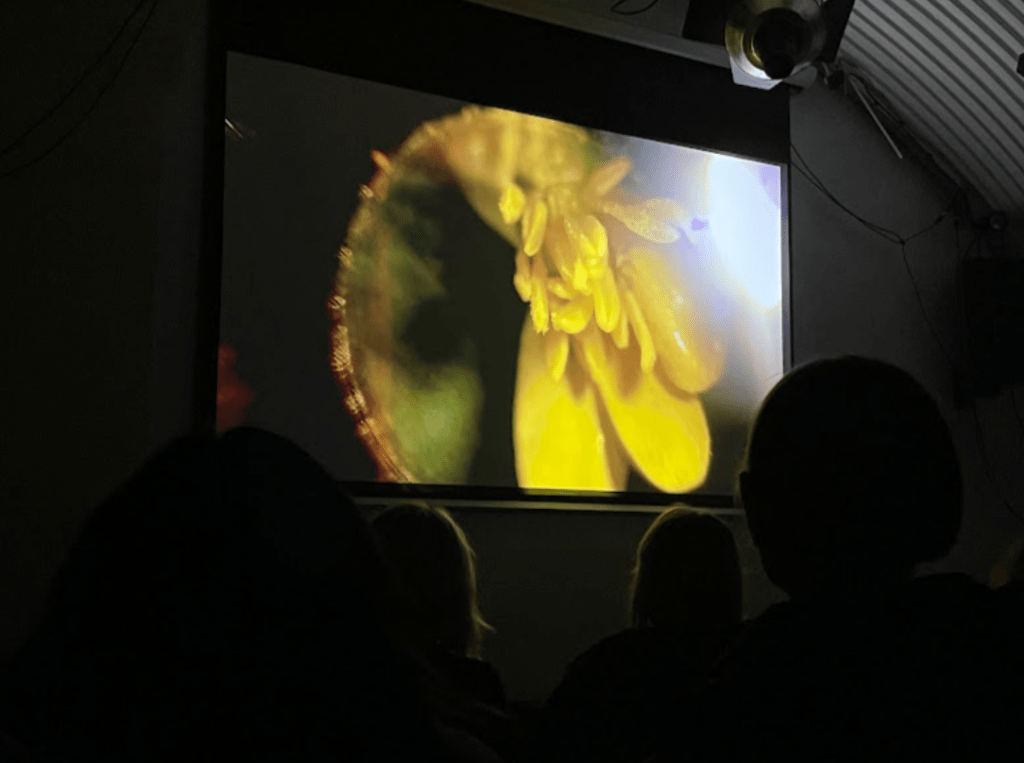
Documentation of If I eat you, will we both still be OK? (Plant)(2024)
Elizabeth Ransom: Can you tell us about how The New Somatic Photographic approach to image making challenges colonialism and assumptions of hierarchy?
Rhone Eve Clews: Photography has repeatedly positioned itself as a neutral witness whilst participating in systems of classification, from colonial anthropology and scientific racism to criminology and ethnography. The NSP asks what photography becomes once it abandons that fantasy of neutrality, questioning photography’s inherited hierarchies
of singular authorship, mastery and separation. It shifts from transactional models of image-making towards relational ones; from extraction, possession and distance towards reciprocity, listening and mutual transformation.
One of the first works where I began thinking about this was through photography’s relationship to tourism, in my work As If My Hand Could Cross That Gap (2016). Before we travel, we typically already ‘see’ the place we’re going to, journeying partly to experience our pre-perceived image of that place and locate ourselves within it.
Stand by that pyramid, lie on that beach, in front of that Eiffel Tower etc. The photograph functions as hard evidence of our arrival. Yet even after gathering the anticipated images, we can’t quite fully ‘possess’ place; a gap remains between us and the image we sought.
Using this potentially unresolvable gap as motivation, I travelled to holiday
destinations making crude physical interventions to rolls of 35mm film, breaking the rules of conventional tourist photography. I scratched negatives with palm fronds and forced seawater, sand, seaweed, even caramelised peanuts (!) into contact with the film, challenging ideas of photographic neutrality or ‘hovering’, and grounding the image within the place where it was made.
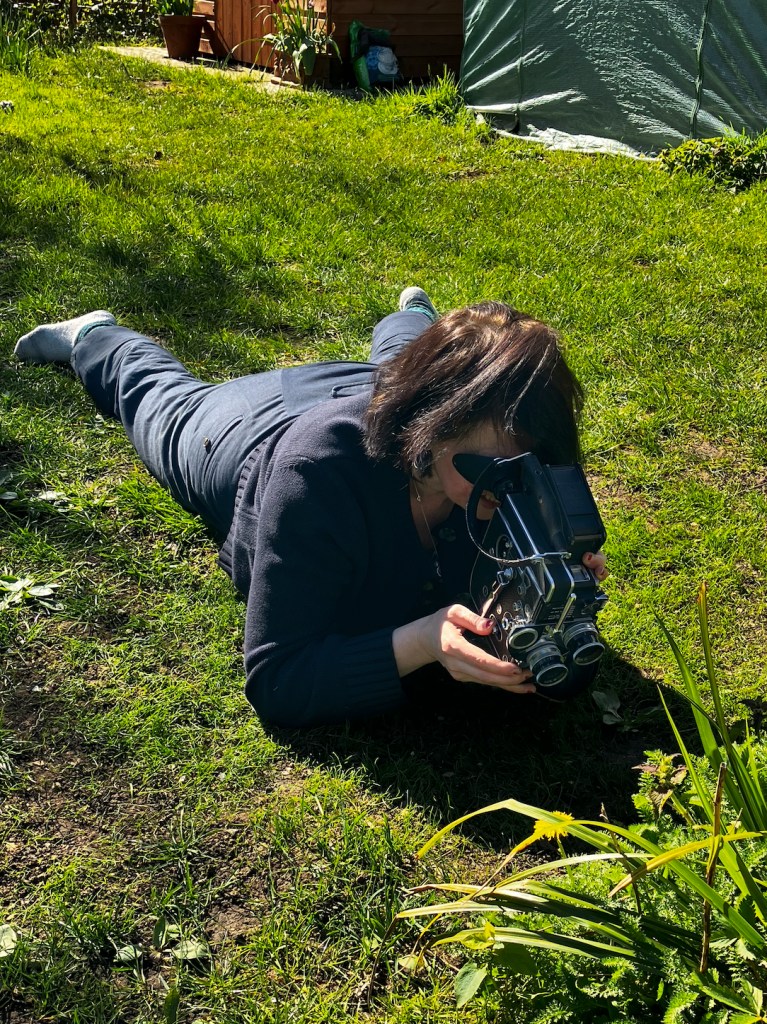
I also get up close and crawl. Making the short film If I eat you, will we both still be OK? (Plant), I crawled across a field in Cornwall with a lo-fi macro lens, taking my body on a feeling-led journey that collapsed some of the default hierarchies that come with being human and upright. Belly down, smushed into bug, dew and buttercup, pollen and insects soon entered the lens housing itself.
Subverting the typified phallocentric lens of natural history, here the camera becomes permeable. Rather than standing above the landscape, filmmaker, camera and ecology temporarily merge into the greater field. I think of this as horizontal making: opening to listen ‘with’ rather than ‘to’, and shifting image-making towards intimacy and mutuality rather than dominance or extraction.
Elizabeth Ransom: You describe your work as “absurd, determined light-sensitive adventures”. Can you tell us about any light-sensitive adventures you are currently working on?
Rhona Eve Clews: Yes, I’m writing this just after taking part in Solar Eclipse Artist Residency (SEAR) in Germany, where I spent time listening with scientists, astrophysicists and artists, learning about how phenomena are translated into different forms of information and experience. I’ve been recording conversations around sensitivity, listening, measurement and the relationship between bodies and scientific instruments. I’m now making a sound work from those encounters, thinking about how light gets
translated into conversation, where an image actually begins, and the differences between something being transmitted through radio, television, photography or the body.
Working at SEAR and looking at the eclipse made me time travel back to a previous light-sensitive adventure, Contact (2015). During an eclipse in Aotearoa New Zealand, I exposed a raw roll of 35mm film directly to it, unravelling and holding the film in my bare hands rather than using a camera. Ten years later, I’m returning to that work and thinking again about contact, distance and transmission, but this time through sound and conversation.
I’m also in post-production on Cosmic Goo: A Short Film About Ectoplasm (2026), my first 16mm and Super 8 film, which attempts to understand ectoplasm through Victorian spiritualism, high-street slime, a qi master’s burps and an ill-fated religious singles night! It’s probably the funniest work I’ve ever made, although underneath the humour are questions about bodies, materials and metaphysics.
Alongside that I’m slowly building the New Somatic Photographic through writing and conversations with other practitioners. I recently spoke about it at Creature, Monster, Stranger, Other, a brilliant conference in Bolton, and several artists came up afterwards saying, “I’m part of this movement!” That was enthralling! I think many practitioners are already working new somatically, though not calling it this – yet!
Lately I’ve also become fascinated by the relationship between photography and language. If photographic emulsion is light-sensitive, I find myself wondering whether language might be sensitive to something else — memory, atmosphere, relation, encounter. Poems sometimes seem to develop experience in ways photographs can’t, just as photographs can hold things language struggles to reach.
For more information about Rhona Eve Clews and her practice please visit her website HERE.
She shone before him like silver (2011)
 Women Alternative Photography Group
Leave a comment