28 April 2026
Interviewed by: Elizabeth Ransom
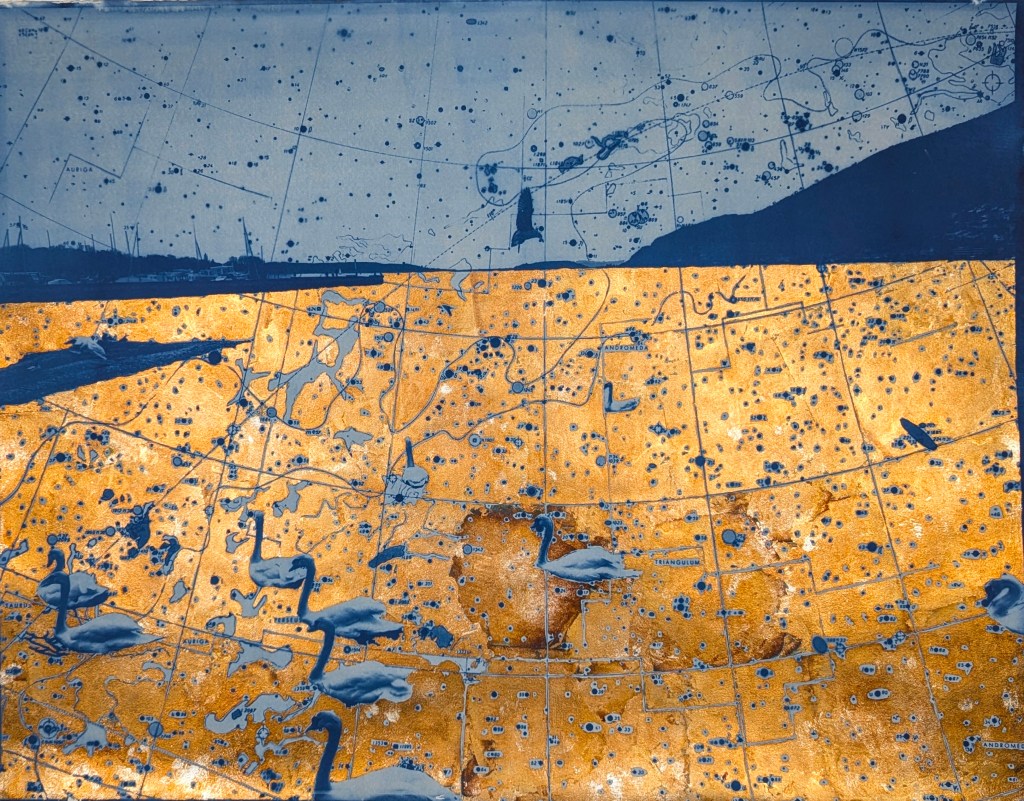
One of the source materials for Nidhi Khurana’s body of work Blueprints of Another Time is one of the most used astronomical atlases of the sky, the Atlas Coeli Skalnate Peso. This celestial map was created by Dr. Antonín Bečvář who documented “all stars brighter that 7.75 magnitude” (Kresak 1983, 147) in 16 large maps. Khurana combines these maps of the night sky with the cyanotype process and gold leaf. These images explore themes of place, time and memory. Through layering of the multiple techniques she investigates how one locates themselves and how individually we define place.
Elizabeth Ransom: In Blueprints of Another Time, you work with discarded and forgotten maps to explore ideas of place, time, and cartographic memory. What first drew you to these materials and what significance do maps play within your creative practice?
Nidhi Khurana: Maps for me work like abstract landscapes, almost as pictures that help me to see where I am. I try to visualize myself inside the map but, am never quite able to reconcile the flat surface of the paper to the full bodied three dimensionality of the real world. I am hardly able to read a map in the way that it can help me to arrive at a spot. I never see it as a definitive guide or the path to reach somewhere. I am curious about how animals, fish, insects and winged creatures navigate.
Maps and the idea of mapping have been central to my practice. It alludes to a real physical fear of being lost but also refers to deeper questions about the structure of power, the hidden meaning of things and the very purpose of life on the planet. Moving between interpretations of land, water and sky maps, from prehistoric petroglyphs to aerial photographs and GPS, the maps I make are invented, fictional landscapes based on my experience of place and time.
“It is not down in any map; true places never are.” – Moby Dick by, Herman Melville
In Blueprints of another time, I have worked with sky maps from the Atlas Coeli, 1950. It has charts of the sky cut into sixteen parts and was unique at the time as an atlas for showing stars, clusters and galaxies visible from an eight-inch telescope. The atlas, named after the Skalnaté Pleso Observatory in Slovakia (then Czechoslovakia) was made by student volunteers under the direction of Antonín Bečvář.
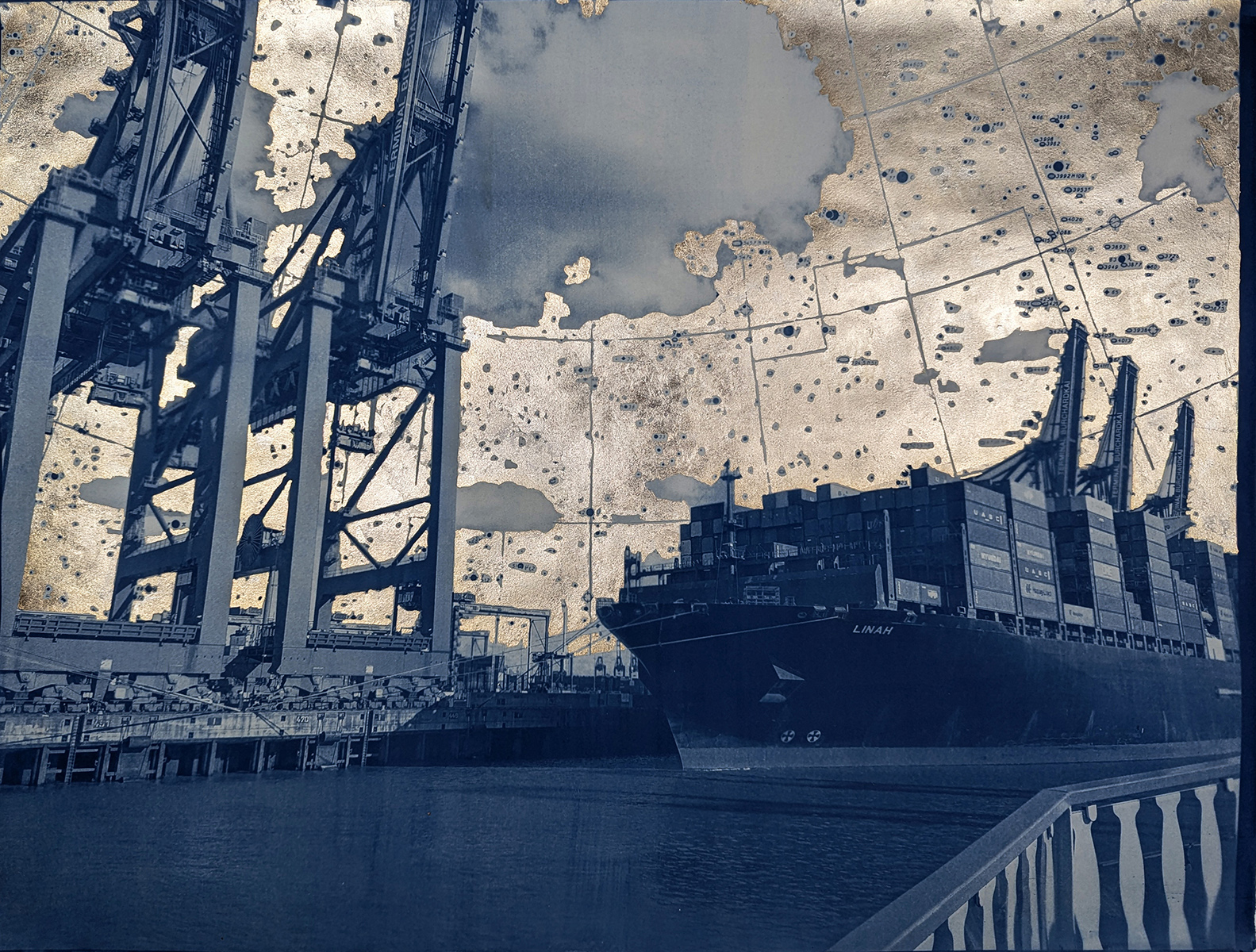
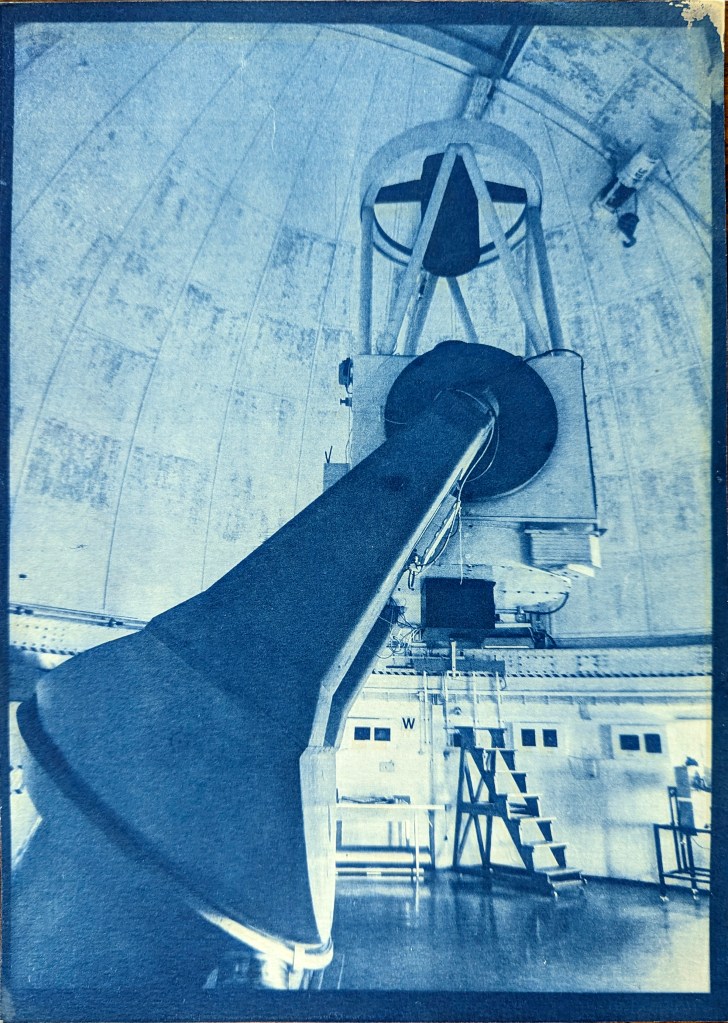
I was in Hamburg, Germany in 2022 for an artist residency program and I found myself at the Hamburger Sternwarte (Observatory) in Bergedorf, looking through a telescope on a clear night in October. I was able to access the atlases of Bode and Bayer from the seventeenth century in the library of the observatory. These maps, created by scientists observing the night sky for years and years lie forgotten in vaults, very much like the view of the stars in the night sky that we hardly witness today. I wanted to bring back this memory of the stars, embedded in our DNA into wider circulation, to remind us that we are nothing but stardust.
Elizabeth Ransom: Place is a significant theme within your work not only as geographical or celestial places but also the relationship between place and memory. How do you think about “place” when working with maps, celestial references, and cyanotype?
Nidhi Khurana: The idea of place is very interesting because place changes according to person. The same place is experienced differently by each person at different points in time. Memory creates associations which help us think of places as we do. A map sometimes works as an entry point for my research into place, leading me down rabbit holes to carry out some wild goose chase.
I love this description of places by Rebecca Solnit from Infinite City: A San Francisco Atlas
a city comprises of many worlds…
” what we call places are stable locations with unstable converging forces that cannot be delineated either by fences on the ground or by boundaries in the imagination – or by the perimeter of the map.” – Rebecca Solnit
Observing the sky through a telescope proved to be a life changing experience in Hamburg and I wrote a story in conversation with Dr. Pranjal Trivedi, astrophysics researcher at Hamburg University. The collaboration, born from continuous conversations about changing perceptions and mappings of the sky over the last 500 years; resulted in the artist book, The Lost Pleiades, that maps my experience of living in Hamburg for three months. It is a story about a journey in time, that invites the reader to explore ways in which meanings are constructed through the interaction of image and text. The Lost Pleiades was created while I was making the artworks for Trans-PORTAL, a solo exhibition designed to map a journey defying gravity and the other three known forces under which all physical phenomena can be defined.
And so, mapping has a lot to do with personal history. This is where photography and image making through cyanotype enter my practice. The process itself is time based and relies on ultraviolet rays from the sun for the prints to form, sealing this connection to the sky. The photographs taken during the residency in Hamburg were converted into cyanotypes in my studio in Delhi in 2023-24 and form the visuals for the book, along with three deconstructed star maps from the Atlas Coeli. In the blueprints series I provide the information on place with the image and title of the work. The map of the stars corresponds to the hemisphere giving a clue to what the sky may have looked like in that spot. To me, this is a gentle nudge to look up and remember.
Elizabeth Ransom: Many of your artworks feature the use of gold and silver. Can you tell us about your process of incorporating alternative photographic process, such as cyanotype, with the use of precious metals?
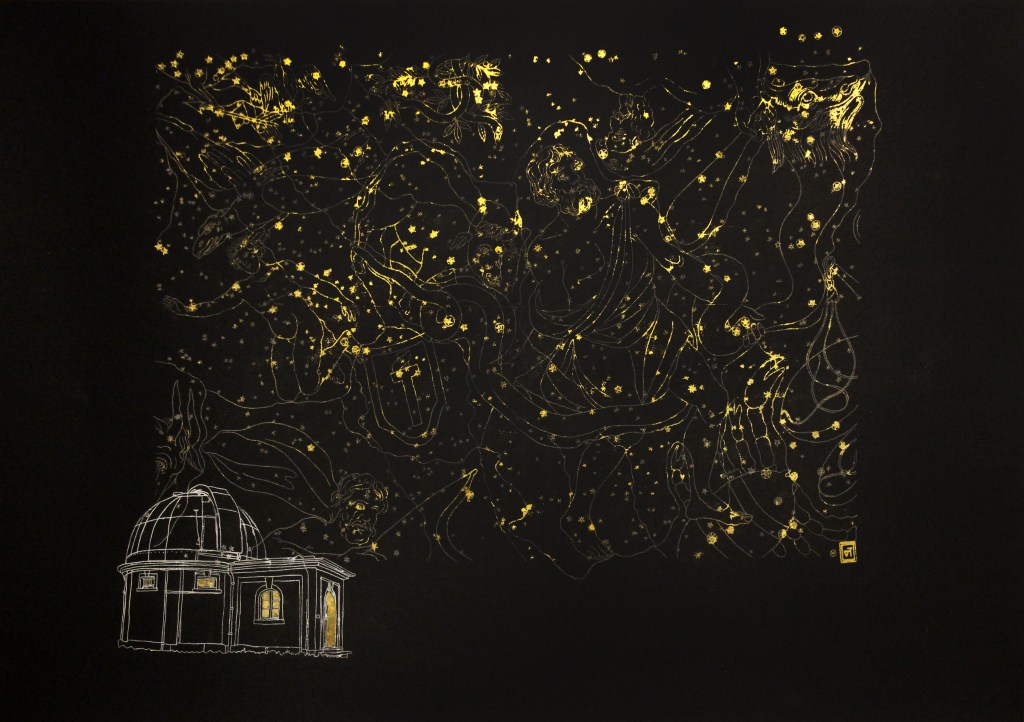
Nidhi Khurana: The gold and silver leaf has been developed as an extension of an ancestral technique used by my family to create artwork for temples. Using gold and silver in my work is an attempt to convey the preciousness, or bring attention to the interconnected nature of everything. E.g. the sky as a sacred space for origin of life on earth or flourishing of plants and forests as essential to all life on the planet. It is also a way to echo the origin of the material in the belly of stars, scattered across the galaxies through supernovae explosions to be deposited deep inside the earth.
I am particularly drawn to silver as it oxidizes, changing into lustrous hues of yellow, orange, pink, purple and blue over a period of time, depending on the climate if the location. The work evolves with the passage of time in a way that the interaction with other colours particularly the blues of cyanotype coerce the viewer to notice new details in the same artwork. I want my work to move seamlessly through art, craft, geography, science and storytelling, uniting the traditional with the contemporary.
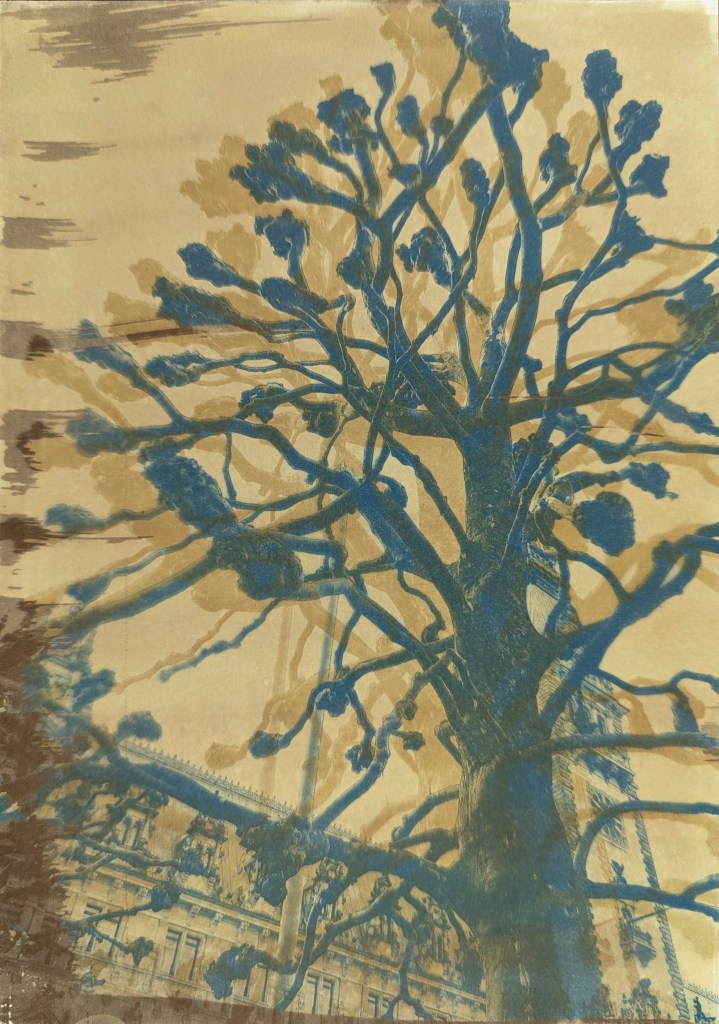
Elizabeth Ransom: In some of your work you combine both cyanotype with vandyke brown. Can you tell us more about this process and how these alternative photographic techniques allow you to convey your concepts and ideas.
Nidhi Khurana: The two techniques allowed for a time lapse to come through the images. Since image making is about light and time, I think about capturing the light travelling from the sky to us and into these images. To reflect this passage of time and allow the viewer to think about the same place from different times; this place was once viewed, photographed, lived in another space time capsule. The streaks of vandyke brown give a peek into this other time, like a slightly damaged film strip from the past.
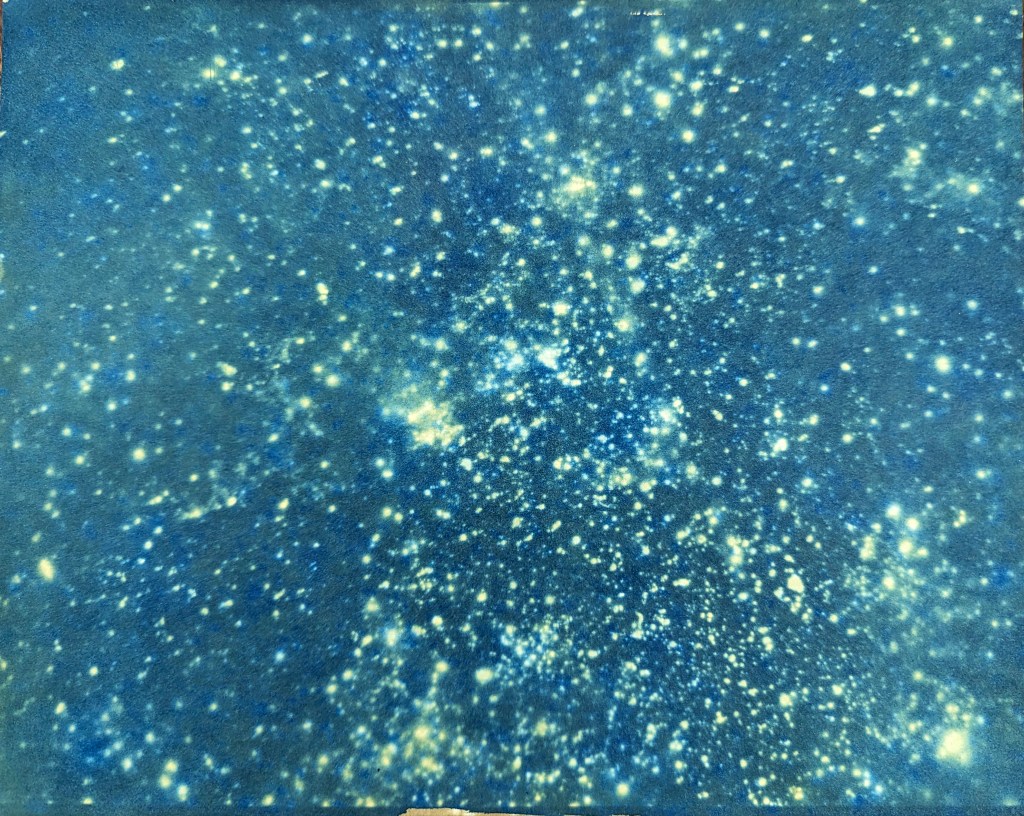
Elizabeth Ransom: Your work often displays traces of touch and physical interventions with the print evidenced through the layered materials, brushed emulsion, and application of silver. How do the tactile, hand made aspects of your process shape the meaning of the work, and what does physical engagement with the materials allow you to express that other approaches wouldn’t?
Nidhi Khurana: I am interested in all the different ways that an artwork can be made and also experienced, not just with sight but also with the other senses like touch, smell, sound, intuition and insight. Working across drawing, textiles, prints, artist books and sculpture, my practice reflects upon the relationship between the human and the natural environment. The work is research-led and material-driven, often shaped through long-term fieldwork, collaboration and observation. Through layered processes and tactile forms, I explore ideas of ecology, memory and place, allowing materials and making to guide meaning.
In the age of mechanical reproduction, physical touch makes an artwork special. It allows for serendipity and play, making the result imperfect and unpredictable. Much like the history of cartography that has been “altered endlessly to reflect different priorities, hierarchies, experiences, points of view and destinations”.
Introduction by Tom MacArthy, of the book “Mapping it Out” An alternative Atlas of Contemporary Cartographies edited by Hans Ulrich Obrist.
For more information about Nidhi Khurana and her practice please visit her website HERE.
Kresak, Lubor. “Becvar’s Atlases.” Kozmos XIV, no. 5 (1983): 147.
 Women Alternative Photography Group
Leave a comment