25 November 2025
Interviewed by: Elizabeth Ransom
In Maria Kapajeva’s project Fluid Borders, she turns to her own upbringing in Narva, Estonia a town situated directly on the border with Russia to reflect on the complexities of national boundaries and displacement. Combining personal experience with collaboration, she works alongside groups of women who have fled war‑torn countries, weaving their stories into the project. Through the cyanotype process, Kapajeva reflects on themes of land demarcation and the shifting, fluid nature of borders.

Elizabeth Ransom: Fluid Borders explores themes of national boundaries and displacement. Can you share with us the inspiration behind working with these topics?
Maria Kapajeva: I’m interested in the idea of boundaries and borders. I was born and grew up in Narva, an Estonian town that sits right on the border with Russia. The border is a river, and my family roots stretch across both sides. Historically both sides belonged to Estonia, but after independence in the 1990s part of that territory remained with Russia. So I grew up with borders as a constant presence.
When I was almost a teenager, I attended art school in a Russian town rather than an Estonian one. This was still during Soviet times, when the border was open, and Narva didn’t have its own art school. After 1991 the border closed, and I began to understand very directly how the opening and closing of borders can shape people’s lives.
As I became an artist, borders remained in my thinking, even if my work did not always focus on them directly. Over the years I developed many different kinds of projects, but only recently did this theme come fully to the foreground. After fourteen years in London, I moved back to Estonia and realised it was finally the right moment to explore the border as an identity: what borders mean for me, and perhaps for others, in a much more layered and comprehensive way.

Elizabeth Ransom: You collaborate with people who have fled their countries because of the full-scale war in Ukraine. Could you tell us a little bit about who these individuals are and how you came to work with them?
Maria Kapajeva: Two years ago, I was invited to a residency at the Baltic Center for Contemporary Art in Gateshead, Newcastle, in the UK. I arrived with the idea of creating a large-scale cyanotype piece around the theme of fluid borders. While there, I met a group of wonderful women from Ukraine who were living in Newcastle as refugees. I decided to run a workshop with them to introduce cyanotype printing. We began by making small prints they could keep, and then I proposed that we create a larger cyanotype work together.
These women were navigating the challenges of displacement and trying to settle in the UK. For me, the project opened up important questions about borders as an especially sensitive topic in the context of the war in Ukraine and the politics of border protection. Yet working together, we tried to imagine what a fluid border could be, and how a river that was named and fixed by people as a border, might instead become a welcoming place for all living beings.

Elizabeth Ransom: Symbolism is central to this body of work, from the use of red fabric to the significance of the river. Could you elaborate on some of the motifs present within this work?
Maria Kapajeva: As I said, I became increasingly curious about rivers as borders and began to think about what actually happens within these waters. We, as humans, decide that a river is a border, but the creatures living in it couldn’t care less. For them, it remains a shared space, a place where coexistence is entirely possible.
The first cyanotype (the blue piece) was created with the Ukrainian women I mentioned earlier. The second cyanotype (the red piece) grew from my interest in the Estonian–Russian border more specifically. I met two artists from Russia who had fled when the war began; they no longer felt safe in their country and stayed in Estonia for a time. We had many conversations about identity and borders, and I invited them to collaborate with me on this second work.
I imagined the red colour as a reference to blood, but also to soil—some parts of the land along the border have a reddish tint. For me, it speaks more to the body and to earthy tones, which contrasts with the blue piece, that feels closer to water and air.
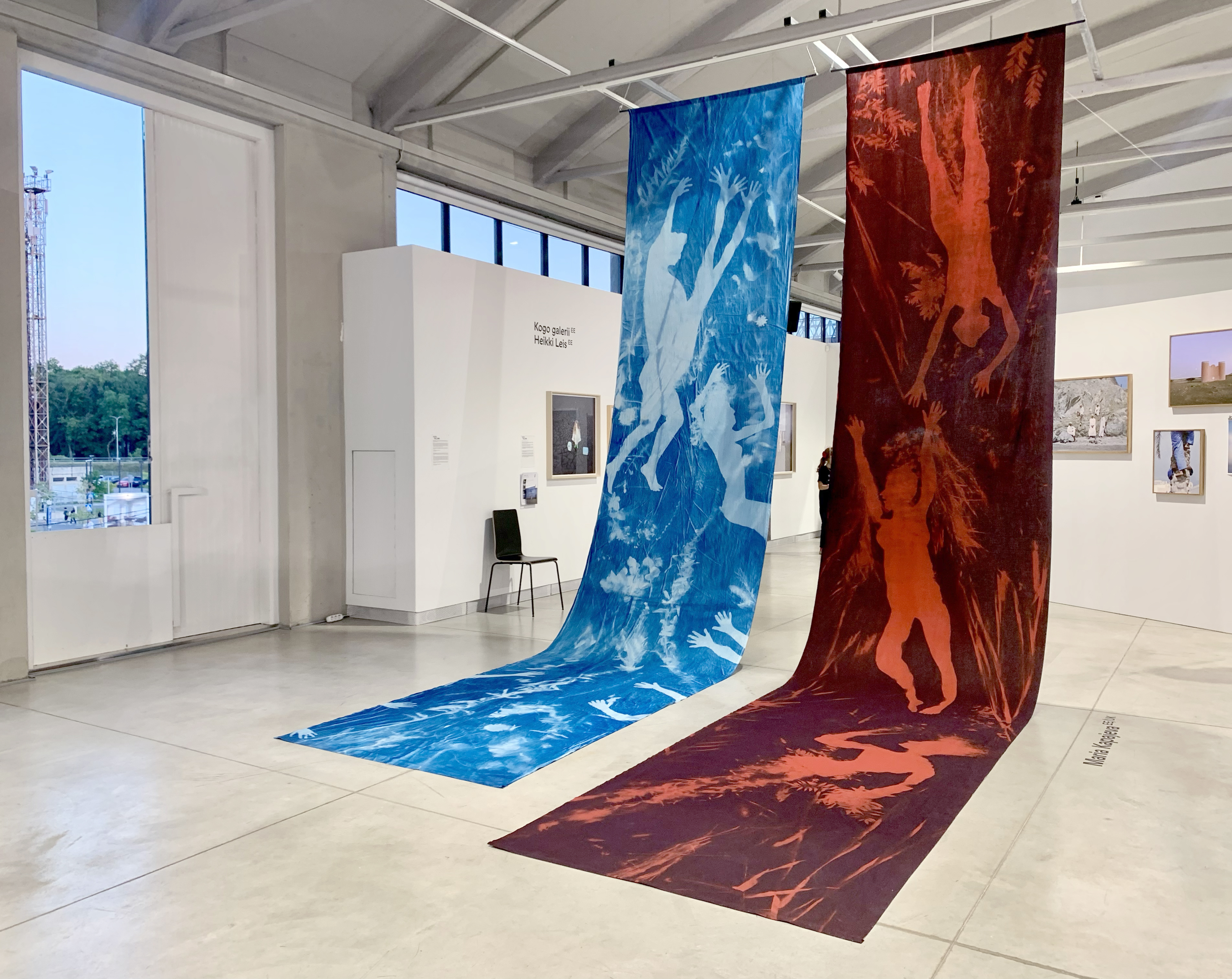
Elizabeth Ransom: The installation is large-scale and involves the placement of plants and the human figure on to large sheets of fabric. Can you discuss the process of selecting these plants with the participants, and how they felt about using their own bodies within this work?
Maria Kapajeva: It was, of course, quite experimental. Because I work collaboratively with different people, it’s very important to give them space to contribute. In both pieces we ended up creating, from our own bodies, creatures that may resemble human figures but ultimately transform into something entirely different. For me, this is a way of thinking with queer ideas—with more inclusive, expansive understandings of what it means to be a living being. Perhaps these waters represent that possibility: the border space becoming a space that accepts everyone.
When it came to plants, I was quite specific in my choices. For the piece created in the UK, I was fascinated by how easy it is to trace the histories of migrated plants. Because the UK is an island—and because so much movement has happened through colonial histories, explorers, and travellers—many plants arrived from around the world and gradually became part of the local landscape. I researched these histories and selected plants I could find in Newcastle, where I spent a lot of time cycling and walking. I chose species I could identify, whose migrant histories I knew, and that were not endangered. Bringing these colonial histories into the work felt important.
Estonia is a very different story. It is a mainland country, and plant migration happens in different ways, making it much harder to trace where species originally came from within Europe. Here I became interested in looking at weeds—the plants considered unwelcome, unnecessary, or invasive from a human perspective. I find it striking how these labels mirror the language used about immigrants, refugees, and people more broadly.
For more information about Maria Kapajeva and her practice please visit her website HERE.
 Women Alternative Photography Group
Leave a comment