
8 July 2024
Interviewed by: Elizabeth Ransom
Working across film, cameraless photography, sculpture and installation Sapphire Goss creates works that leave nothing to waste. Using expired film and antique lenses, Goss revives disused photographic objects in her unique creative practice. In many of these abstract works, Goss explores the physicality of photography experimenting with different modes of making. Her works investigates uncanny feelings about time and place creating a multisensory experience for her audience.
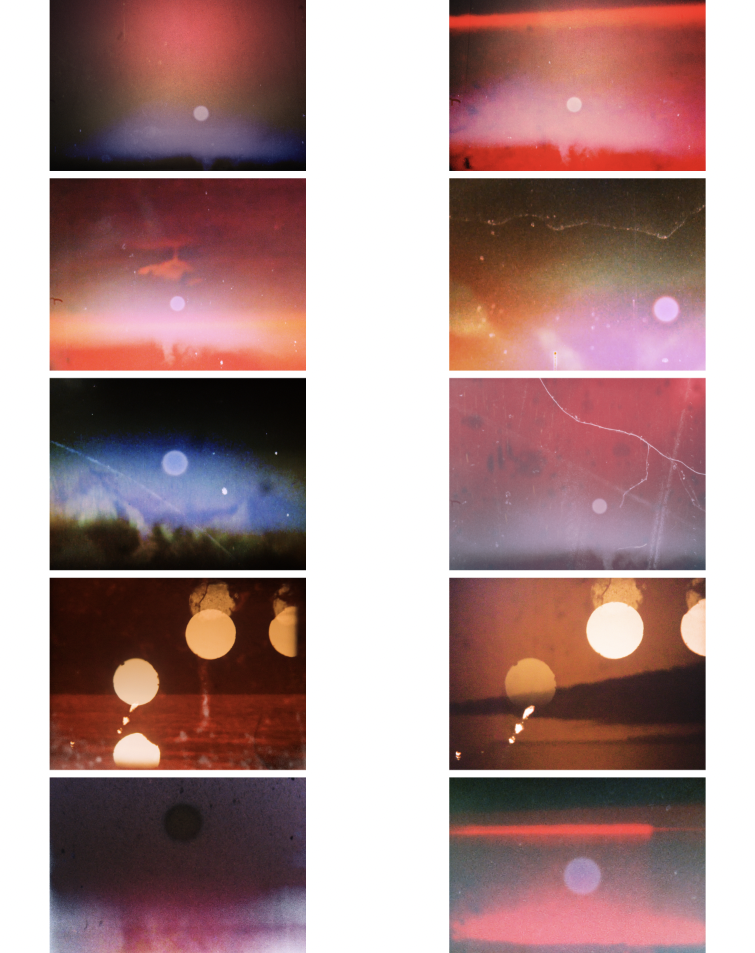
Revenants: Compound Horizons (2023) Digital video from 8mm/16mm, sound, 9’00” single channel Monitor, Wood, antique TV magnifier https://www.sapphiregoss.com/horizons
Elizabeth Ransom: In many of your works you use obsolete or forgotten photographic materials such as expired 35mm Kodachrome film in your work Slow Glass Windows I&II and expired film from the 1940s in your work Revenants: Compound Horizons. What is it that draws you to these particular photographic materials from the past and how does reviving these overlooked films inspire your process?
Sapphire Goss: I began using expired film for reasons of economy – first in 35mm/120 and later with 8mm/16mm. Fresh stock is increasingly expensive, and I prefer feeling free to experiment and make mistakes rather than being too precious, especially when I am learning new processes. And of course the flip side to this is you get very unpredictable but often beautiful results – colour shifts, emulsion flaws, grain, and sometimes even other people’s forgotten photos coming through. There is something quite compelling about unearthing these objects that have been forgotten – exposing light onto them through the layers of chemicals and materials that were assembled many years ago, before I was born. Some were made in a wholly different world from today – the USSR still existed for example. It might be overly romantic but I feel that these objects are imbued with their own traces of time or memories, and by bringing the objects back to life these properties are unearthed. I like that they make everything look moody and evocative, and the material properties blend into the imagery. In Compound Horizons I leaned into this a lot, using sprocket holes and the edge of the frames as landscapes in their own right. I’m really into that sense of pareidolia – which is where you see shapes in clouds and the like, images slowly emerging from grain and matter. The edges of the film reels make horizons, holes are suns or moons, static/grain bleeds into light on water into stars, chemical forms into clouds – exploring and shaping the terrain of the celluloid. I am really influenced by Pavel Filinov, a Russian painter from the early 20th Century. He’s only had a handful of international exhibitions but I was lucky enough to see an exhibition of his in St Petersburg in around 2006. It was incredibly beautiful, the room was in darkness with the paintings lit up, and they seemed to breathe and move. He talks about this idea of ‘universal flowering’ where everything had to come from the cellular to its creation, and I am aiming for a similar type of process whereby the artwork grows from its form but also its elements/chemicals/light particles like a plant – growing, alive, scaling up and down from the molecular to the cosmic.
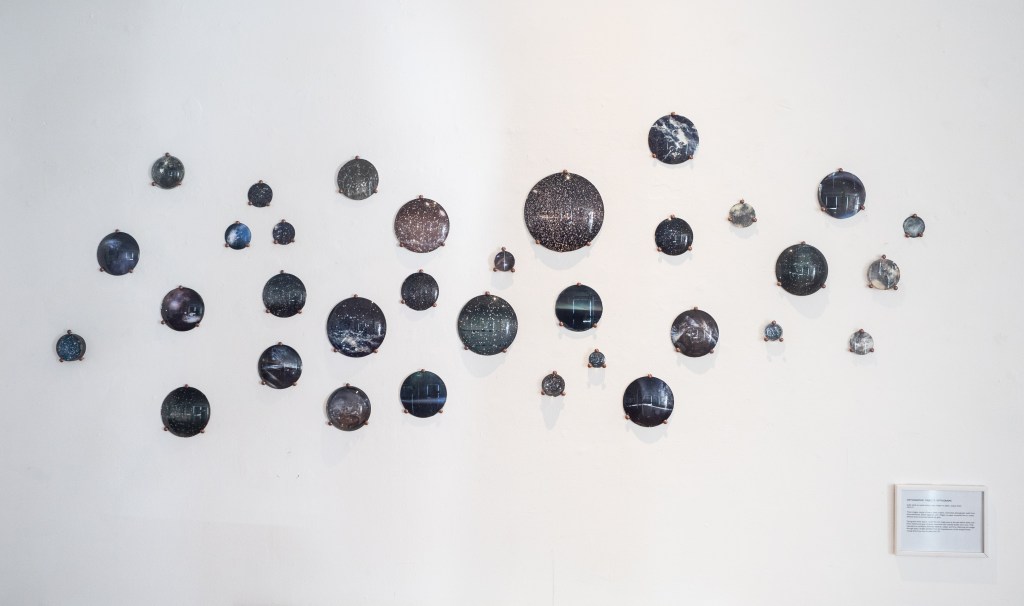
Optographic Objects: Optograms, Giclée prints on crystal archive, inkjet collages on paper, antique lenses, 2022-23
Elizabeth Ransom: Your series Optograms uses antique lenses and cameraless photography techniques to create droplet like objects. Can you tell us a little bit about what inspired this work?
Sapphire Goss: Influenced by others online, I first started off mounting vintage and weird lenses at first onto my DSLR but later on analogue cameras: magic lantern lenses, projector lenses, the lens from a 1930s torch, making my own liquid lenses out of plastic bottles, filming through viewfinder prisms, making bokeh filters from waste materials and ice… I developed a bit of an eBay addiction, enabled by lockdown, and began to buy cheap job lots of vintage camera equipment in various stages of disrepair, and boxes of optical lenses from unknown sources. I was fascinated by these as objects in themselves, the way the light bubbled through the glass. And the idea of glass itself as neither solid nor liquid, but its own thing; in suspension, somehow living. Around the same time I read a book by the science fiction writer Bob Shaw, Other Days Other Eyes, who had a concept, “slow glass”, through which light travels so slowly it could record time. I thought of these optics as ‘eyes’, by which looking through it is like seeing through the eyes of time, layers of materials.
So I have made sculptural pieces with antique glass and other photographic ephemera, as well as using them to record the films and photographs I make. Optograms mounts cameraless photos, closeups of antique glass, and paper. These images consist of macro shots of glass, cameraless photographs made from discarded/waste 35mm negatives, and collages made by scratching into paper, creating these delicate lacey structures behind the glass. It was believed that optograms could record the last image seen by the eye before death, and these objects are simultaneously eyes, droplets, molecules, celestial bodies. One of my favourite parts is that it gives a 3D effect, raising the images away from the flat plane and distorting them as you walk around them. This is something I have used again with Mechanical Marvellous where the film is mounted behind an antique lens to give depth, inspired by graphoscope viewers. I am fascinated too by the idea of photography as alchemy, and those early days where it must have felt like magic as well as science. Where you are first seeing inside the body, time captured, things beyond human perception.
As an interesting aside Bob Shaw sadly lost his sight, and I also have an eye condition called uveitis which causes pain and photophobia. Perhaps partially the root of some of these obsessions for both of us.
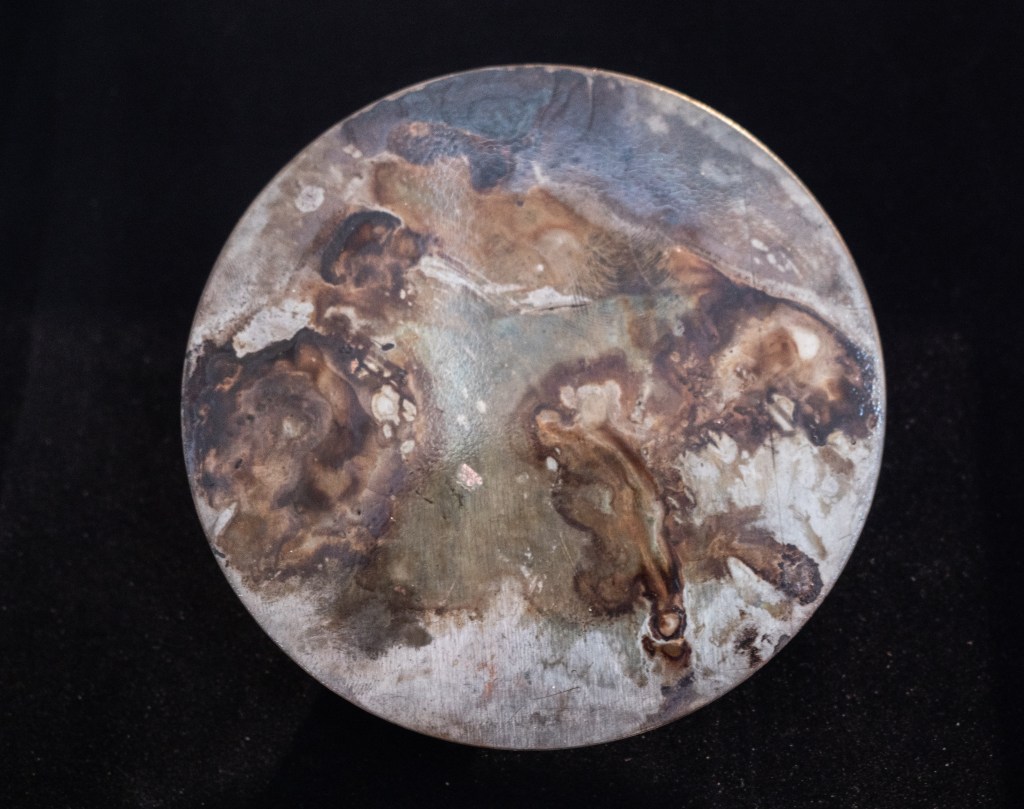
Optographic Objects: Copper Chemigrams, Silver extracted from photographic fixer on copper sheets, wood, 2022-23
Elizabeth Ransom: In your series Slow Glass Windows I&II you use a developer made from coffee which is a darkroom process that is less toxic and detrimental to the environment. You also reuse exhausted waste photographic fixer in your work Optographic Objects: Copper Chemigrams I-XV. Can you tell us about these two projects and the use of more sustainable approaches to photography within your practice?
Sapphire Goss: In Slow Glass Windows I&II I had developed a roll of Kodachrome in caffenol and the remjet layer had created these strange cloud formations which I would never be able to recreate. Caffenol is a process I use a lot with Kodachrome in cine film too. It can no longer be developed officially in colour (though people like Adrian Cousins are recreating the process). I think as a ‘dead’ format it is interesting to bring it back to life using more sustainable methods.
The Copper Chemigrams came about because I had seen Melanie King’s project making jewellery with expired fixer – and not realising they had used electrical currents to do it I bought these copper discs and painted on the exhausted fixer. Luckily it worked! It extracts the silver from the chemicals and creates these strange metallic cloudlike landscapes. I have started to do bigger versions too. It makes the fixer less harmful to the environment as well.
Clearly working with silver chemistry, other toxic chemicals and plastic film is never going to be fully sustainable but I try at least to never let anything go to waste. I use any film that didn’t work out, or the end bits, for cameraless experiments or for workshops for example and reuse spools etc. I am thinking of doing something with all of the film boxes and printed materials at some point, maybe to paint liquid emulsion onto or make paper – if anyone has any tips. And yes my studio is very full and very untidy!
A final point is that we are very disconnected from the environmental impact of digital photography too – from the appalling conditions of coltan miners in the Congo, to the labour practices in the manufacture of technology, to the huge power demands of the supposedly invisible cloud servers, to e-waste impacts and the rest. Again I try to buy as little new technology as possible and be mindful of these aspects.
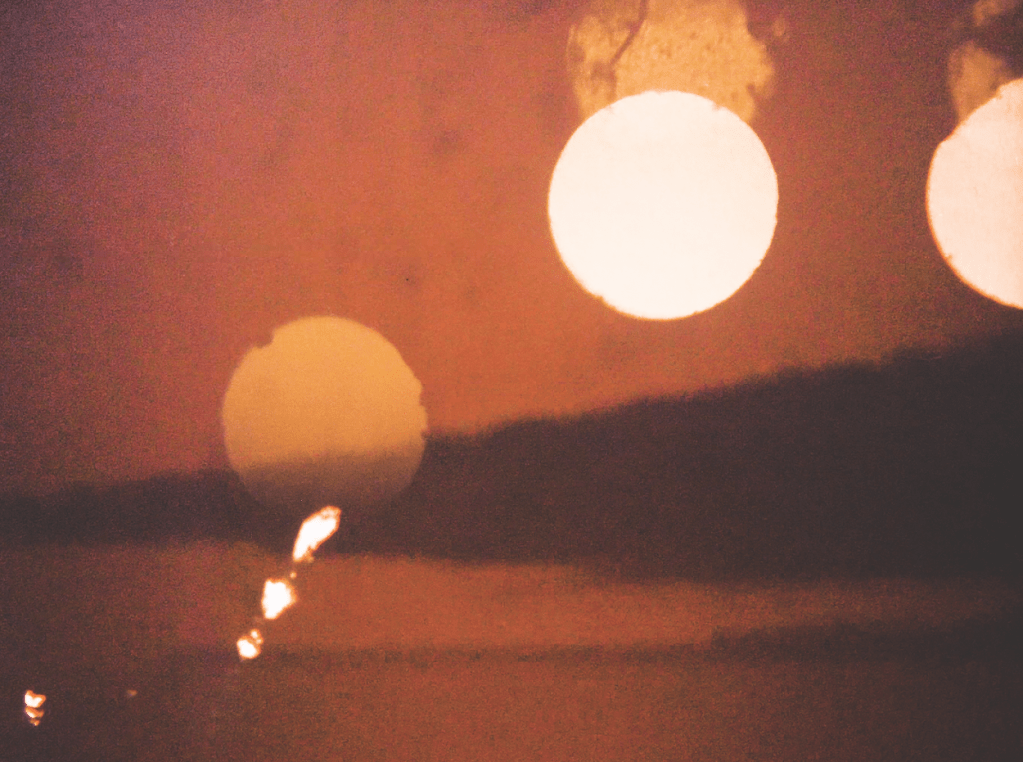
Revenants: Compound Horizons (2023) Digital video from 8mm/16mm, sound, 9’00” single channel, Monitor, Wood, antique TV magnifier
https://www.sapphiregoss.com/horizons
Elizabeth Ransom: From window panes to antique lenses, your work draws attention to the materiality of photography. It goes beyond the idea that photography must exist as traditional prints framed and mounted in a white walled gallery space and instead interrupts exhibition spaces with physical, sculptural like creations. Could you tell us a little bit about the physicality of your work and what propels you to use photography in this way?
Sapphire Goss: Even when my films themselves have been ‘digital’ I have often tended to use some form of physical intervention: things in front of lenses, sequences printed onto paper and reanimated, projections onto plants or suspended in space. I think following on from the previous point about current technology is that we can feel cut off from the tangible sense of things. Working with physical space and materials – and in analogue in particular – is very sensory in contrast – the touch of things loading in a dark bag, the sound of the shutter and the clockwork motors whirring, the smells of the chemicals and the musty boxes, the dirt under your fingers when you are developing (I always forget to wear gloves!), even the injuries where a spring has snapped are all part of what makes photography addictive for me. I love getting back to those physical fundamentals of light and dark and time and materials – and the interplay between those things. For example when we are watching an analogue film the reason the movement makes sense to us is that there is as much darkness as light. We are watching 24 images a second with a black flicker in between, and our brain makes up the difference in between using persistence of vision. I wonder if the fact that we are finishing the images ourselves gives the feeling of films as dreams, something very powerful. I find even the most seemingly banal physical processes fascinating in that sense.
Revenants: Compound Horizons (2023) Trailer
And I think when it comes to the subject of my work, I am trying to embody these uncanny feelings about time and place and being that I don’t have words for, and the physical sensations and experience are very much a part of that. I aim to make work that is meta-visual; multisensory almost in a synaesthetic sense: films you can almost taste, a sensory feeling under your skin and in your gut.
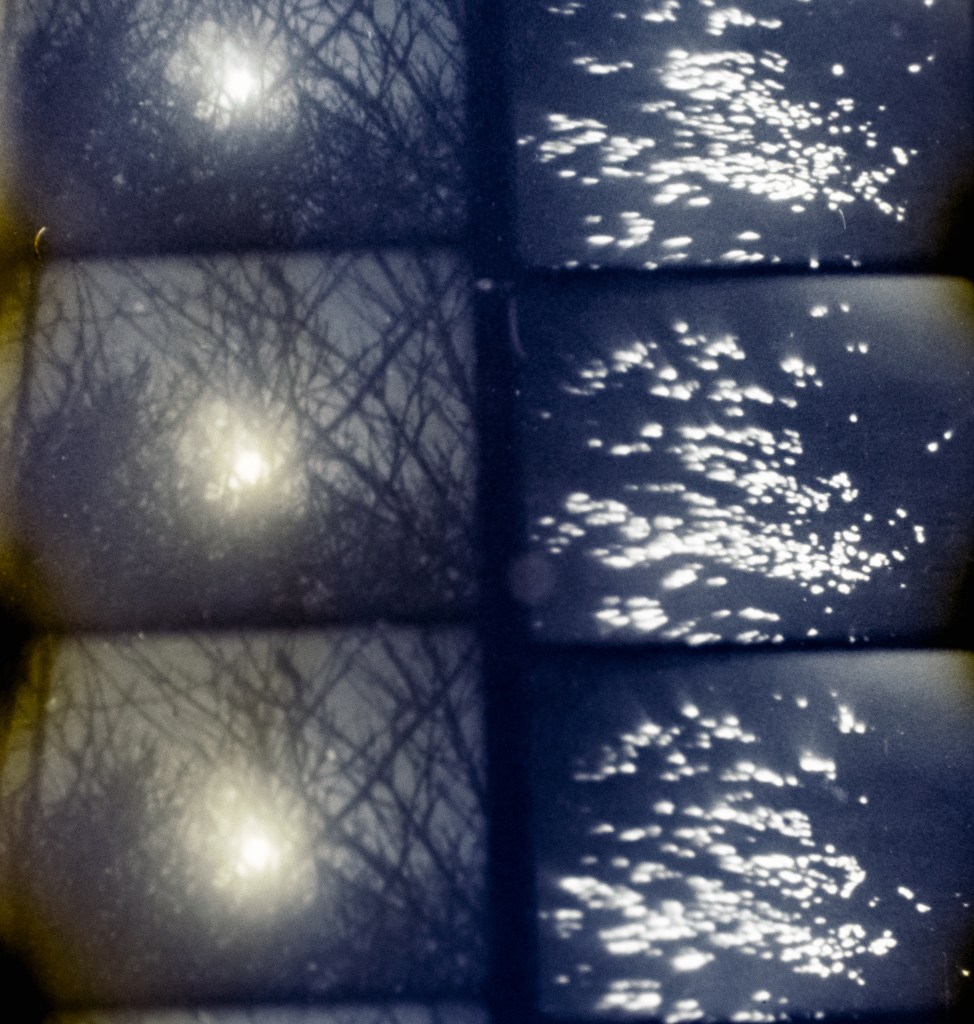
Shotska Reel (2022) digital video from 8mm, sound, 03’40”, open edition. Single channel, Scans from 8mm film
https://www.sapphiregoss.com/movingimage/shotska
Elizabeth Ransom: In addition to creating sculptural photographic objects, you continue to use cameraless photography in your video works that are accompanied by soundscapes. These sound pieces are created in collaboration with other artists. Could you share with us what it was like to work with these artists to create your video pieces?
Sapphire Goss: Making visuals for musicians and sound artists is how I started out so these collaborations will always be special to me. Each relationship is unique. Sound has often been a key jumping off point for what I was making – I often spent time when I was young listening to music and visualising imagery in my head. That switched around as my confidence grew, making soundtracks to the films, building existing tracks with soundscapes and working on more of a dialogue with the collaborators. At the moment I am really into making my own sound using a similar approach to the visuals to create a unified whole: using field recordings, the sounds of the projection/editing machines with optical samples that have warped and degraded, and some video to sound synthesisers. I like the idea that the films are materially creating their own sound world – or imagining what sonic space these material/chemical worlds inhabit. I am also starting to experiment with the optical sound reader on my projector and cameraless film, and I have bought a bunch of old magnetic tapes to draw on/warp and manipulate and I’m looking forward to experimenting with these processes further. I think that it’s also the case that I approach the way I build my video works like pieces of music: ebbs and flows, textures and dynamics. I would love people to experience the work like that too; compositions of light, time, chemicals and emotions.
For more information about Sapphire Goss and her practice please visit her website HERE
Shotska Reel (2022)
 Women Alternative Photography Group
Leave a comment