
25 April 2024
Interviewed by: Elizabeth Ransom
Femicide is defined by UN Women as “an intentional killing with a gender-related motivation, femicide may be driven by stereotyped gender roles, discrimination towards women and girls, unequal power relations between women and men, or harmful social norms” (UN Women). The majority of perpetrators are family members or intimate partners, but in many cases the killer can also be someone unknown to the victim. Gender related killings are not specific to any one country, but is a universal experience. Often times indigenous women are disproportionately affected by gender related killings. Artist Natali Bravo-Barbee uses the cyanotype process to draw attention to the astonishing number of women who die from femicide every year.
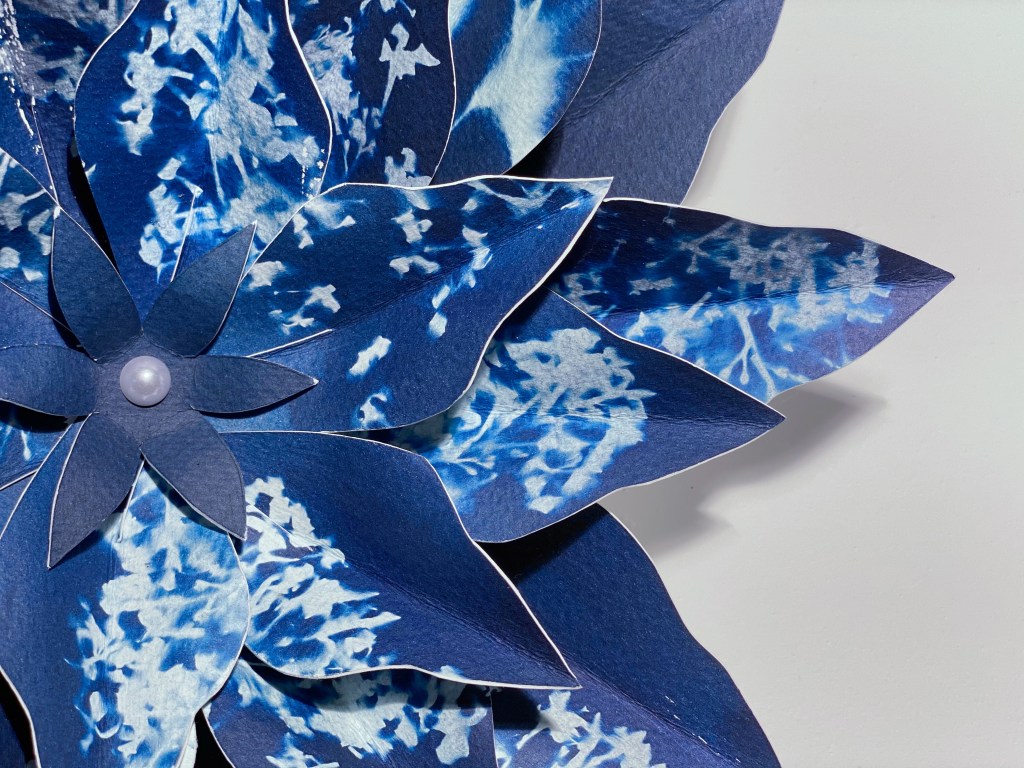
Elizabeth Ransom: In your series Flores de Femicidio you create three dimensional cyanotype flowers to represent the 327 women who died in your home country of Argentina due to femicide in 2019. Could you tell us a little bit about the femicides that are taking place all over the world and how it inspired this incredible project?
Natali Bravo-Barbee: Yes, although the Flores de Femicidio project takes a micro perspective by just analysing gender-based violence in Argentina, I like to keep myself updated on femicides happening worldwide. When I started researching femicides, I was introduced to the topic through the extremely high rates of women being murdered in Mexico. After reading several horrible news reports of women being found violated and deceased, I wondered what the rates were in my native country. From there, I became aware of the use of hashtags being used to highlight femicides in Argentina (e.g., #niunamas).
Femicides happen daily, and local governments are not doing enough to protect women. It is only through local groups of women gathering to speak up and highlight these issues that tends to become the driving force for change. I have been following Australia’s fight against femicides. They have been using the hashtag or catchphrase “She Matters: (NAME)” to highlight news of current femicides on the social platform known as X. I think this is a helpful tactic because only through repetition do patterns emerge and become noticeable.
Locally, I have been disheartened by the recent attack on 19-year-old twin sisters in Brooklyn, NY. One sister (Samyia Spain) died as a result of the attack that was brought on by their rejection of advances made by a man who was hitting on them while they were shopping at a local deli. It is stories like this that make it obvious that femicide is an issue in our own backyard. It is not just someone else’s problem; it is our problem, and that is what keeps me in this fight.

Elizabeth Ransom: In this work you create intricately detailed flowers by hand to represent each individual woman that has lost their life. Each flower takes sometimes as long as ten hours to craft. Could you share with us your process and how you used the light sensitive technique known as cyanotype within this piece?
Natali Bravo-Barbee: I have been working with cyanotypes for nearly a decade, and I’m still fascinated by it! Cyanotypes are also called sun prints because they are exposed using UV light (the sun) or blueprints because they are blue in their natural form (when they are not toned).
Cyanotypes have become a significant part of my visual language. If you visit my Instagram page, you will notice the various ways I have incorporated the process into my practice over the years. Initially, when I learned about alternative process photography, I refused to make ‘floral cyanotype prints’ just because I thought it was overdone. I think Anna Atkins did an excellent job of creating a beautiful visual language that everyone wants to emulate. So I made myself a promise that if I was going to make floral prints, they had to be truly meaningful to me. That’s why I turned to the floral motif as a symbol of honour, memory and, of course, cyanotypes lend themselves so well to this.
Here is the process I follow: I use templates to trace the petals, cut the petals, number each piece, coat the petals with cyanotype chemistry, expose, develop, shape and assemble. I use dried flowers to expose images on each petal individually. In other words, the dried and pressed flowers become the negatives I used to expose each print on every single petal. In my work, I also use a lot of lace. The lace is a metaphor for memory, and many of the flowers have lace patterns on them. As a whole, I exposed thousands of individual prints to make the 327 cyanotype paper flowers that make up the memorial known as Flores de Femicidio/Femicide Florals.

Elizabeth Ransom: You take great care to research each individual woman’s story gathering information from news articles to create an archive for each victim. In your research how did the media represent these gender-based crimes and did you have any difficulty accessing information?
Natali Bravo-Barbee: When I began my research, the topic of femicides was hot. In Argentina, the media was closely paying attention to the stories of women being murdered by men. At the start of 2019, the media was reporting closely and accurately many details of each reported femicide, but as time went on, and interests dwindled, less information was being shared. However, just because the interest declined, that doesn’t mean that the rate of femicides decreased, it remained close to one femicide taking place every twenty-seven hours.
It started off with first names, last names, age and entire recollections of their murder and statements made by loved ones. By June, the media was just giving their first name and an initial for their last name, their location, and a brief summary of their murder. By the end of the year they were reduced to just initials, age and location and one line telling the story of their murder. I was lucky if I found the entire story in one article. So you can say it became more difficult to access information.
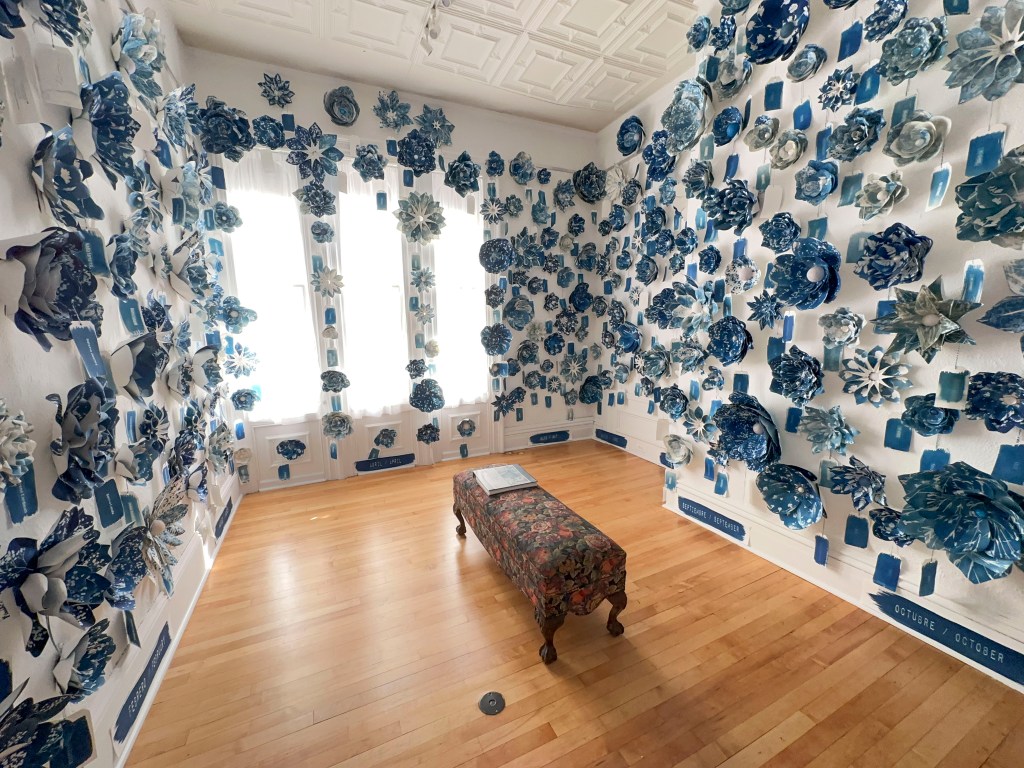
Elizabeth Ransom: When exhibited, this project encompasses the entire gallery space filling every nook and cranny with vibrant blue flowers. Can you tell us a little bit about the impact of presenting the work in this way as a memorial for those who have lost their lives?
Natali Bravo-Barbee: I have come to learn that when people shout or scream, it is often because they feel unheard. I wanted to depict this feeling visually. I asked myself, how can I shout “WE HAVE A PROBLEM OF WOMEN BEING MURDERED BY MEN!” with my artwork? The answer was to fill the room with stand-ins that represent each victim of femicide. This will show that we do have this problem and that we need to talk about it.
I feel that people tend to react differently when I say “327 women were murdered through femicide” versus when they walk into a room and see 327 flowers, each symbolizing one of the victims. Allowing the viewer to have that moment of discovery is a significant part of educating on this issue.

Elizabeth Ransom: This body of work speaks specifically to the acts of violence against women that took place in Argentina in 2019, however this is not a new phenomenon, and it is also something that takes place globally. Projects like Flores de Femicidio are a great way to advocate for women and raise awareness for these devastating murders, but what more do you believe needs to be done to end femicide?
Natali Bravo-Barbee: This is a powerful question. Unfortunately, I don’t see an end to femicides in our lifetime. I want to be hopeful and not grim about it but the truth is we are a long way from making this a reality. However, I think it all starts with highlighting and educating. I often say that once the media and news outlets start using the term femicide in every headline about femicides, we will see how often they occur, and only then will it become apparent that this is an issue that we desperately need to address.
Hopefully then politicians and policymakers will realize that action needs to be taken. We need special laws that are directly geared to protect women, but what good is a law without impunity?
Many Latin American countries have implemented laws, but they aren’t really causing the change one hoped it would. So we need to take a closer look at that and ask why? Why are the numbers not decreasing? Why aren’t the police doing more to protect women? What can we do differently in our community, state or country to have a better outcome?
For more information about Natali Bravo-Barbee’s work please visit her website HERE

For further information on femicide you can read the 2023 publication “Gender-related killings of women and girls (femicide/feminicide): Global estimates of female intimate partner/family-related homicides in 2022″ created by UN Women and UN Office on Drugs and Crime.
References:
UN Women (2023) Five essential facts to know about femicide At: https://www.unwomen.org/en/news-stories/feature-story/2022/11/five-essential-facts-to-know-about-femicide (Accessed 24/04/2024).
 Women Alternative Photography Group
Leave a comment