25 July 2023
Interviewed by: Elizabeth Ransom
From our dependence on fossil fuels to the Great Pacific Garbage Patch it’s hard to ignore the impact human’s have had on the climate crisis. But what can be done to help remedy the situation? What can creatives do to address these issues? Artist and Professor Cara Jaye uses her creative practice to raise awareness for environmental issues such as plastic pollution and king tides. By combining art making methods Jaye’s work promotes action and encourages viewers to take the necessary steps towards a more sustainable planet.

Pre-Emptive Memorial for Single Use Plastic – Strawberry Clamshell Box, screen-print, 11” x 14”, 2021
Elizabeth Ransom: Your series Pre-emptive Memorial for Single Use Plastics draws attention to the overabundance of plastic in our everyday lives. From shopping bags to plastic straws, we are inundated with single-use plastic that finds its way into our water systems harming wildlife and destroying ecosystems. What led you to investigate these themes within your practice?
Cara Jaye: I was led to focus on these items as I contemplated my own consumer habits, and that of my family. So many food items are tied to plastic packaging, from preparing school lunches to purchasing new items like strawberries. Avoiding all plastic when purchasing or preparing food seemed impossible to me. I was re-using and washing old baggies and trying to get everyone on board, but convenience has a huge impact on our habits. New items like berries are very difficult to buy in anything but a plastic clamshell box; these would pile up in our recycle bin. I was reading about how few recyclables are successfully recycled, and it was depressing. Do we give up berries? How do you affordably purchase strawberries without the boxes they come in? There must be another way.
At the same time, I was reading articles like this recently published one in the New Yorker – titled “How Plastics are Poisoning Us”(1). This review goes into detail about various books and authors who investigate the plastic problem.
“Just about everyone who contemplates the “plastic pollution crisis” arrives at the same conclusion. Once a plastic bottle (or bag or takeout container) has been tossed, the odds of its ending up in landfill, on a faraway beach, or as tiny fragments drifting around in the ocean are high. The best way to alter these odds is not to create the bottle (or bag or container) in the first place.”
I was coming to the same conclusion – can’t we make a better, more sustainable container? Wouldn’t it be great if an engineer or materials designer came up with something different, and we no longer had these things in our life? In fact, I believe the technology may exist, but it is not in wide production or use. I was dreaming about a possibility in the future when we might say – “remember those dome lids that used to come on our Frappuccino’s?”, and we would think nostalgically about these mundane items, kind of like some people do with VHS tapes or phone books. I wanted to make something that celebrated the item as something that is gone – a memorial – except it’s not gone, so these are pre-emptive memorials. These works look toward a more hopeful future where we no longer have all these throwaway plastic items creating dire environmental consequences.

King Tide I, cyanotype, monoprint and graphite on paper, 88” x 90” (12 panels each 22” x 30”), 2018
Elizabeth Ransom: Not only does your work investigate plastic pollution but also issues such as flooding, sea level rise, and storm surge. How has living in Bellingham, a city on the coast of the Pacific Northwest of America, impacted your creative process?
Cara Jaye: It feels very special to live in Bellingham, WA. This is a beautiful area to live in located on the coast of the Salish Sea, near the mountains, and surrounded by the dense, luxurious forest. It is easy to get outside and be near or on the water. I was studying king tides a couple of years ago and learned a great deal. Being able to see these in person makes the information much more tangible. King tides are exceptionally high tides that happen several times a year, and with these come flooding in some coastal areas. Since king tides lift the water level higher than a typical high tide, they offer a glimpse into the future of what we might expect with sea level rise. The city of La Connor, located about 35 miles from Bellingham experienced a severe king tide last December, and the entire downtown flooded. The first place I showed the King Tide pieces was in La Connor, at the Museum of Northwest Art (MoNA), several years prior. These pieces were made for and included as part of an exhibition called Surge in 2018. Surge is an exhibition designed to draw attention to climate change and its impact of the Northwest’s coastal communities(2). I am currently working on some new pieces to be included in the newest manifestation of Surge, titled Surge: Mapping Transition, Displacement, and Agency in Times of Climate Change which will take place this fall at MoNA. I am using cyanotype again in these works; however, I am focusing on the issue of CO2 in the atmosphere. I am excited to exchange ideas with my scientist mentor Dale Durran, Professor of Atmospheric Sciences at the University of Washington. I am motivated and inspired by his research on CO2 in the atmosphere and a quote he shared, “Individually, we make isolated choices that may have only a tiny impact on CO2 levels, but that impact will echo almost forever.” The idea of echoing and rippling helps me to visualize an ongoing force that will be the starting point for new creative work.
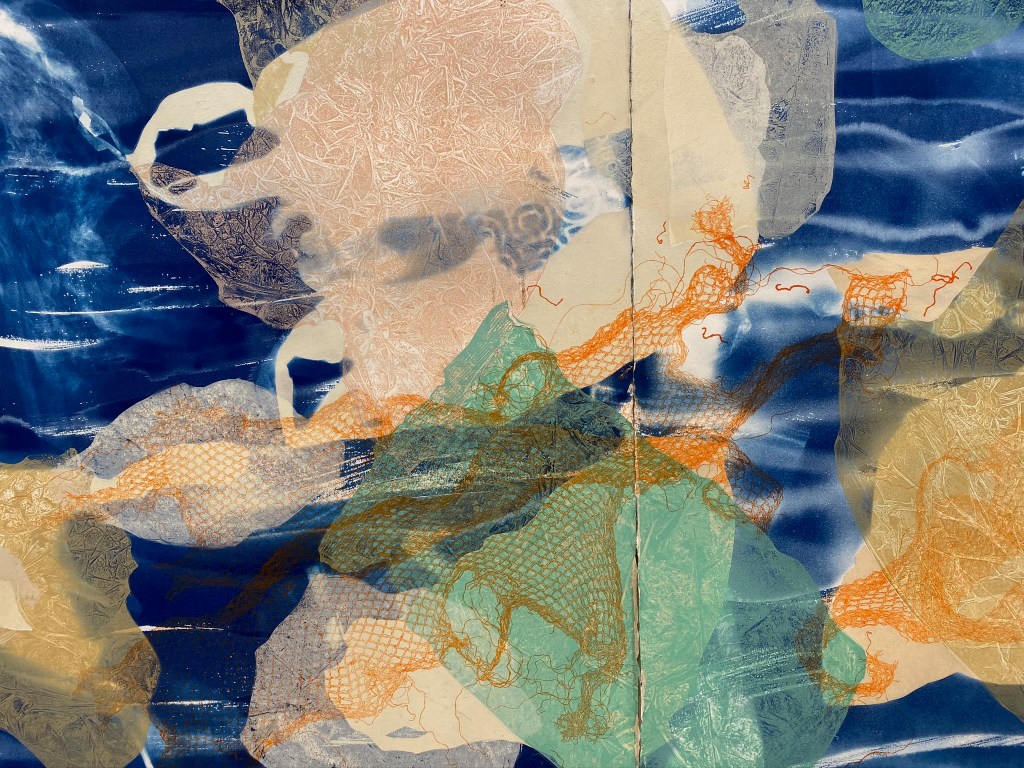
You Are Drinking Plastic – detail, cyanotype and monoprint on paper, 220” x 30” (10 panels each 22” x 30”), 2019
Elizabeth Ransom: In your practice, you combine the historical photographic process of cyanotypes with screen prints, monoprints, relief prints, and paintings. Can you tell us a little bit about these processes and what inspired you to use these techniques in your work?
Cara Jaye: I have been using cyanotype in concert with other media such as silkscreen, monoprint and paint for a long time. I find the cyanotype suggests both water and atmosphere, and I find it makes a strong ground for further layers of material. Being able to make work on an absorbent ground that also accepts a lot of other mediums is a huge plus for me. I come from a background of painting and drawing, but I always was very invested in photography and printmaking as well. I have spent a lot of time making photographic work and teaching photography to students. Alternative photo processes are one of my favourite things. I think it is the mixture of the photo element combined with a loose, less predictable outcome that for me is a sort of hybrid between painting and drawing and photography. For a long time, the van dyke brown print was my favourite process, but lately I have been using the cyanotype for the most part. As I mentioned above, the blue colour works well with the environmental issues I am exploring. Additionally, I like its historical associations with Anna Atkins, that it is economical, relatively safe and easy to work with, and that it is a stable medium.

Pre-Emptive Memorial for Single Use Plastic – Jug and Ziploc Bag, gouache, and cyanotype, each 15” x 19”, 2022
Elizabeth Ransom: The climate crisis is a real threat that will not only impact future generations but is already causing mass migrations, triggering extreme weather events, and destroying the homes of some of our most vulnerable communities. It can be overwhelming to face the harsh realities of the damage that has already been done. How do you handle the anxieties and fear that arise when researching these topics?
Care Jaye: These topics are terrifying and do induce anxiety. This is why I started making work about climate change in about 2017. It helped me to process the information, and to feel that I am doing something to contribute in a positive way. It is so easy to feel helpless, and like nothing you can do makes a difference. As an artist I cannot make wholesale change, such as enact new legislation, however I can exert my visual voice. I feel like public opinion has changed during the 6 or so years I have been making this work. I believe that a lot of it is the terrible environmental disasters we are experiencing more often and so rapidly – fires, floods, all kinds of extreme weather. It seems to me that more people are acknowledging climate change, and the deniers are less loud. It is frustrating that change is happening so slowly, but the more public opinion is unified, the sooner we can start enacting some positive movement.

You Are Drinking Plastic – detail, cyanotype and monoprint on paper, 220” x 30” (10 panels each 22” x 30”), 2019
Elizabeth Ransom: What role do you see art playing in the wider discourse on the climate crisis? What can artists do to make a difference?
Cara Jaye: There is a whole movement of environmental artists going back decades. Each can bring their voice to the discussion in a variety of ways. Artists celebrate nature, propose alternative ways of living or thinking about the world, they raise awareness and can promote action. Art is excellent for positioning an idea in subtle and overt ways that get people to think about issues differently. Art can stick in your mind, because it is visual, it is emotional, and it is personal. Art can be like storytelling, and that is something that resonates for people and can help change perspectives and begin to enact change.
For more information about Cara Jaye’s work please visit her website HERE

You Are Drinking Plastic, cyanotype and monoprint on paper, 220” x 30” (10 panels each 22” x 30”), 2019
[1] https://www.newyorker.com/magazine/2023/07/03/book-reviews-plastic-waste
 Women Alternative Photography Group
Leave a comment